The Invisible Hand
Every herding trial has a course designer, and almost nobody talks about them. Handlers discuss dogs, judges, sheep, and weather. They rarely discuss the person who decided where the panels stand, how far the outrun stretches, and which direction the drive turns. Yet the course designer shapes outcomes more than any other single factor aside from the dog itself.
I have walked trial fields with course designers before the first dog runs. I have listened to them explain why they placed a drive panel forty yards left of where everyone expected it. I have watched handlers study course maps with the intensity of generals reading battlefield terrain. What I have learned is that course design is not logistics. It is strategy, and understanding it separates good handlers from great ones.
What a Course Designer Actually Does
The course designer’s job starts weeks or months before the trial. They visit the field, walk the terrain, and begin mapping a course that will test specific skills while remaining fair across all runs.
A standard Open course includes these elements arranged across the field:
The handler’s post — where the handler stands for the entire run. Placement matters. A post on a slight rise gives the handler better visibility. A post in a hollow forces the handler to trust the dog on portions of the course they cannot fully see.
The set-out point — where the sheep wait at the far end of the field before each run. Distance from the post to the set-out defines the outrun length, typically 400 to 600 yards at Open level.
Fetch panels — gates the sheep must pass through on their way to the handler. These define the ideal fetch line.
Drive panels — gates positioned to create the triangular drive pattern. The angle and distance of these panels relative to the post determine how challenging the drive will be.
The pen — a small enclosure where the handler must direct the sheep inside. Its position on the field affects how the run flows from drive to pen.
The shed ring — a marked circle where the handler must separate specific sheep from the group. Not every trial includes a shed, but championship courses always do.
The designer decides all of these positions. Each decision creates consequences that cascade through every run.
Terrain Is Not Neutral
The most important variable in course design is one nobody installs: the terrain itself. Flat agricultural fields, rolling hills, creek beds, tree lines, and slopes all influence how sheep move and how dogs work.
I attended a trial in Montana where the course designer used a shallow draw — a depression running across the middle of the field — to devastating effect. The drive panel sat just beyond the draw. Dogs approaching on the correct line lost visual contact with the sheep for roughly ten seconds as both dog and sheep descended into the depression. During those ten seconds, sheep that had been walking calmly would often drift, and the dog had to read the situation blind.
“That draw is the trial,” the course designer told me with a grin. “Any dog can drive sheep on flat ground. I want to know which dogs can drive sheep through terrain that takes away their advantage.”
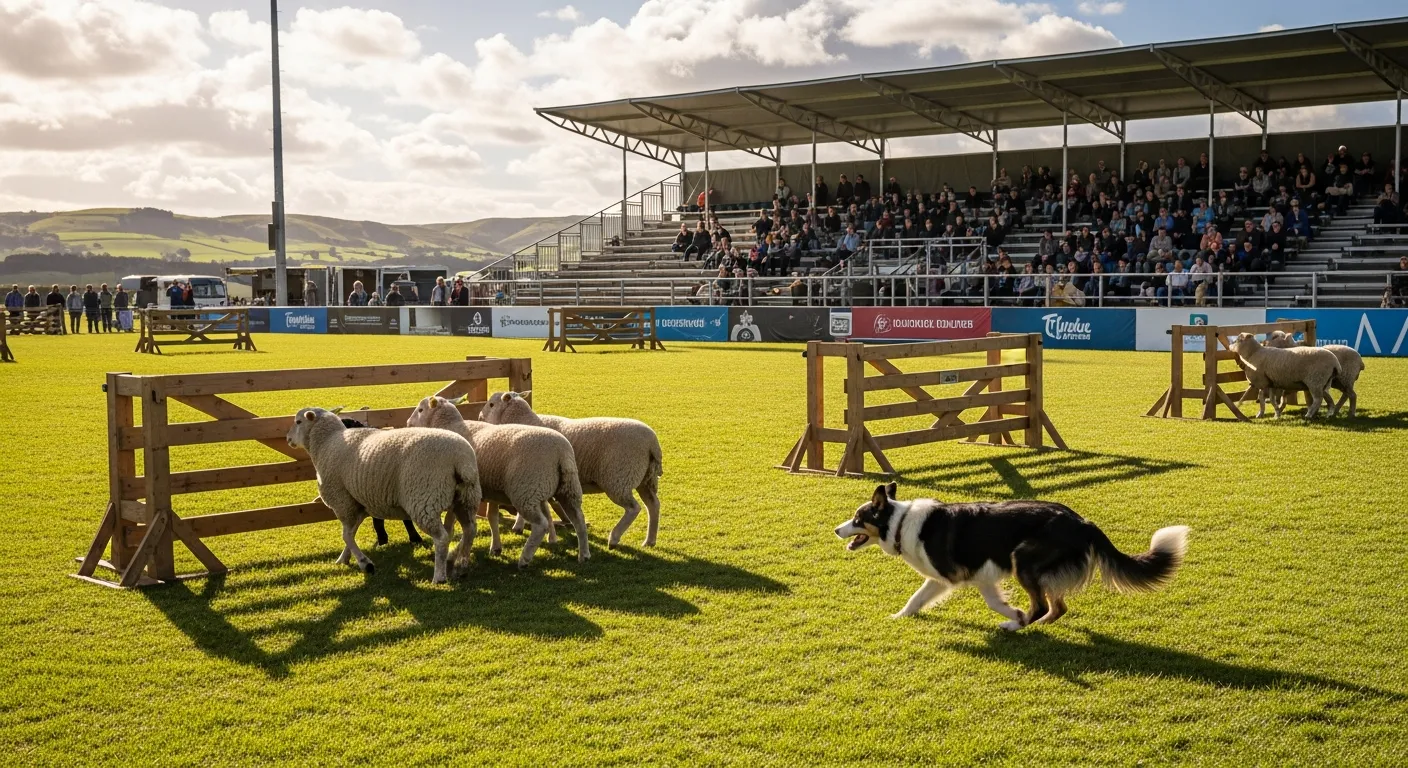
This philosophy reflects a tension within the sport. Some handlers and organizers want courses that showcase clean, beautiful work on ideal terrain. Others believe courses should test adaptability, which means incorporating the natural challenges of the land.
Both approaches have merit. The clean course produces spectacular runs that spectators can follow easily. The challenging course reveals which dogs truly think and which dogs merely obey. The best course designers find a balance, creating a test that is visually compelling and technically demanding without being unfair.
The Psychology of Panel Placement
Drive panels are where course designers exercise the most influence over scores. The angle of each drive leg, the distance between panels, and their relationship to natural terrain features can make a course accessible or brutal.
Consider a simple example. If the first drive panel is set at a gentle angle off the fetch line, the transition from fetch to drive is smooth. The sheep are already moving in roughly the right direction. A minor adjustment from the dog redirects them onto the drive leg.
Now move that same panel thirty yards further out and angle it sharper. Suddenly the transition requires the dog to completely change the sheep’s direction of travel. Sheep that were walking comfortably toward the handler must now turn ninety degrees and head across the field. The dog must reposition. The sheep resist the change. Points evaporate.
“Panel placement is where I make my statement about what this trial should test,” explained course designer and former handler Margaret Atkinson at a trial management seminar I attended. “Close panels with gentle angles test precision. Wide panels with hard angles test power and authority. I decide what story the course tells.”
Atkinson’s courses are known for their difficulty. Handlers grumble about them before the trial and respect them afterward. Her philosophy — that a course should require the full range of a dog’s abilities — produces lower scores but clearer separation between excellent and merely good runs.
Reading the Course Map
Experienced handlers study the course map obsessively. At major trials, the course map is posted the evening before competition begins, and handlers gather around it the way stock traders study market charts.
What they look for:
Distance relationships — How far is the outrun? What is the total drive distance? Longer courses favor dogs with stamina and handlers who can communicate at extreme range. The whistle systems and command structures that handlers develop become especially critical when distances stretch beyond 400 yards.
Angles — What angles do the drive legs create? Sharp angles are harder than gentle ones. A course with two 90-degree drive turns is significantly more challenging than one with two 45-degree turns.
Terrain interaction — Where does the course cross difficult terrain? Is there a slope that will pull sheep off line? A fence line that sheep will want to follow? A gate in a distant fence that sheep know leads to their pasture?
Wind direction — Course maps do not show wind, but handlers overlay wind predictions onto the course. Wind affects how sheep travel, how sound carries, and where dogs need to position. A crosswind on the drive leg means the dog must compensate for sheep drifting downwind.
Pen position relative to exhaust — Where sheep exit the field after the run affects their behavior at the pen. If the exhaust gate is visible from the pen, sheep may cooperate because they see the way out. If the exhaust is behind them, sheep at the pen have no obvious exit, which creates resistance.
How Course Design Affects Different Breeds
Course design interacts with breed characteristics in ways that occasionally spark controversy. USBCHA courses are designed for the distances and working style where Border Collies excel. This is not accidental. The organization exists to promote Border Collie working ability, and the courses reflect that mission.
But even within Border Collie competition, course design creates advantages and disadvantages for different running styles. A dog with a naturally wide outrun benefits from a course where the set-out is placed near a fence — the fence prevents the dog from running too wide, effectively correcting a tendency that might cost points on an open field.
Conversely, a dog that tends to cut in on the outrun is punished more severely on a course where the set-out is in open ground with nothing to encourage the dog to stay wide.
For handlers who compete with breeds other than Border Collies, course design can determine whether a trial is worth entering. Courses with extreme distances effectively eliminate breeds that do not have the Border Collie’s range. Courses with shorter outruns and more technical elements — tight pen work, difficult sheds, complex drive patterns — give other breeds a better chance to demonstrate their working ability.
The Shed: Where Design Meets Drama
The shed is the most technically demanding element in course design and the most dramatic for spectators. The designer determines how many sheep must be separated, which sheep are marked, and where the shed ring sits relative to the rest of the course.
A well-designed shed creates a genuine test of the dog’s ability to work in close quarters with authority and precision. The handler must identify the marked sheep, create a gap in the group, and call the dog through that gap to hold the separation.
The position of the shed ring matters enormously. A ring placed near the middle of the field with no natural boundaries requires the handler to maintain separation using only the dog. A ring near a fence gives the handler a natural barrier to work against, making the shed significantly easier.
At the 2024 National Finals, the shed ring was placed on a slight uphill grade with no fences nearby. This meant sheep could drift in any direction during separation attempts. Handlers who typically completed sheds in thirty seconds found themselves working for two minutes. The course designer had elevated the shed from a routine element to the decisive phase of the trial.
Fairness and Controversy
Course design generates controversy when handlers believe the course is unfair. Unfairness in course design typically means one of two things: the course is so difficult that no team can demonstrate quality work, or the course creates variable conditions that affect different run times unequally.
The second concern is more legitimate. A course where the afternoon sun creates a blind spot on the drive leg disadvantages afternoon handlers. A course where morning dew makes a slope slippery but afternoon heat dries it out creates different footing conditions. Terrain near the pen that turns to mud after twenty runs of sheep traffic changes the test for later competitors.
Good course designers anticipate these issues. They walk the field at different times of day. They consider drainage patterns. They adjust panel positions to minimize time-of-day effects. But no course is perfectly equal across all conditions.
“I aim for ninety percent fairness,” Atkinson told me. “The last ten percent is weather and luck. If a handler blames the course for their score, I listen. Sometimes they have a point. Usually they do not.”
What Handlers Can Control
Given that course design is fixed before the first run, what can handlers actually do with the information?
The answer is prepare. Walk the course if permitted. Study the map if walking is not allowed. Visualize each phase of the run on this specific course with this specific dog.
Some handlers adjust their strategy based on course design. A long outrun might prompt a handler to send their dog on their stronger side. A difficult drive angle might lead a handler to position sheep slightly off the ideal fetch line to set up a better approach to the first drive panel.
The integration of course knowledge into handling decisions connects directly to what judges evaluate. A handler who sacrifices a point on the fetch to gain three points on the drive has made a smart tactical decision that the score sheet will reward.
At organizations like Working Dog Standards, there is growing discussion about standardizing course design principles to ensure that trials across different regions test comparable skills. Whether this standardization improves or diminishes the sport depends on whom you ask, but the conversation reflects an increasing recognition that course design is not a neutral background element.
The Course Designer’s Legacy
The best course designers are remembered by handlers long after specific trial results are forgotten. Their courses become reference points in conversation. “Remember the drive at that Caldwell course?” handlers say, the way musicians reference legendary performances.
This recognition is deserved. A well-designed course reveals truth about dogs and handlers that a poorly designed course obscures. It creates moments of brilliance that only exist because the test demanded them. It produces fair competition where the best team wins not through luck or favorable conditions but through genuine excellence across every phase of work.
The next time you attend a trial, look at the course before you look at the dogs. Study the terrain. Notice the panel angles. Consider why the pen sits where it sits. The person who made those decisions shaped everything you are about to watch.
The course is the story. The dogs and handlers are the characters. And the best course designers write stories that only the most skilled teams can finish well.