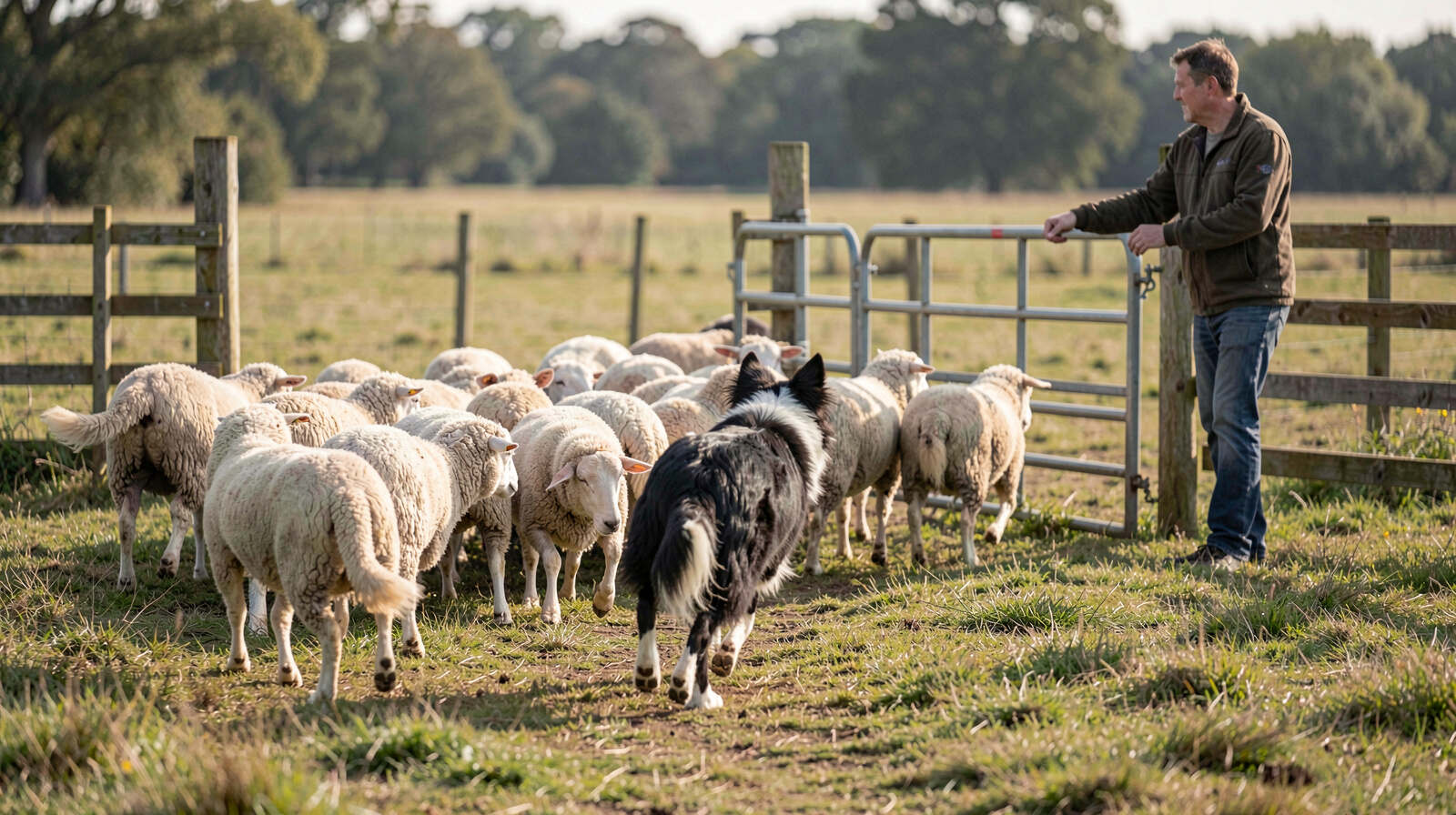
Why the Drive Holds the Most Points
On most Open courses the drive is worth around thirty points, more than the outrun, the lift, or the fetch. Judges weight it heavily for a simple reason: the drive is the only phase where the dog pushes stock away from the handler, through gates, on a shape the dog cannot fully see the value of. Everything before it brings the sheep to the post. The drive sends them back out and asks the dog to keep them dead straight while doing it.
The standard drive is a triangle. The dog takes the sheep on the away-drive to the first set of gates, turns them, runs the cross-drive on a straight line across the field through the far gates, then turns again for the pen or shed. Most handlers think in terms of the panels. Judges think in terms of the lines between them.
That distinction is where points disappear.
The Line Costs More Than the Panels
Newcomers fixate on making the gates. They will sacrifice a clean line to jam the sheep through a panel, then feel good about it. Judges do the opposite. On a 30-point drive, missing one set of gates typically costs a fixed deduction, often a handful of points. But wobble, wandering, and constant correction across the whole length of the drive bleed a point here and a point there on every segment, and that arithmetic adds up faster than a single missed panel.
A run that makes both gates on crooked, over-corrected lines will usually score worse than a run that misses one gate but holds two long, calm, straight lines. The sheep should travel as if drawn on a string. Each time the dog has to swing wide to fix a drift, the judge sees the drift and the correction, and pays for both.
So the working priority is line first, gates second. If you set a good line early, the gates tend to arrive on their own. If you chase gates, you spend the whole drive fighting the line you never established. This is the same principle that governs the outrun: get the shape right at the start and the rest falls into place.
Reading the Line From Behind
The hardest part of the drive is that you are judging a straight line from the worst possible angle: directly behind the sheep. From the post, a group drifting ten yards off line looks almost correct. By the time it looks wrong from behind, it is badly wrong.
Experienced handlers solve this with reference points. Before the run, walking the course, they pick a fixed object on the horizon, a tree, a fence post, a hill notch, that sits behind each gate. During the drive they steer the sheep at the marker, not at the gate, because the marker is visible the whole way while the gate vanishes into the grass at distance. They also read the line off the trailing sheep rather than the leaders, since the back of the group reveals drift a beat earlier.
The cross-drive punishes this blindness most. It runs left to right (or right to left) across your field of view, so a small angular error translates into a large miss by the time the sheep reach the far gates a couple of hundred yards away. Tiny early corrections, given calmly and well before the gates, beat the big desperate flank you are forced into when you wait. Good command timing here is the same discipline you build everywhere in handling: correct early and small, not late and large.
The Two Turns
The triangle has two turns, at the first gates and again after the cross-drive. Both are quiet point-sinks. A turn should be a smooth pivot that keeps the group together and immediately establishes the new line. What actually happens under pressure is an overflank: the handler pushes the dog too far around, the sheep overshoot, swing past the new line, and the dog has to bring them back, costing a correction the judge sees clearly.
Drill the turns as their own exercise at home. Set two gates at an angle and practise nothing but the pivot, asking for a tight change of direction that loses no ground. A clean turn sets up a clean cross-drive; a sloppy turn means you start the longest, most exposed segment of the run already off line.
The Deductions Handlers Forget
Beyond line and gates, three things quietly erode drive scores:
- Pace. Sheep driven too fast scatter and bunch; driven too slow they graze and stall. Steady, deliberate movement reads as control. A drive that is merely fast is not a good drive.
- The dog cutting in. A dog that swings wide to flank but then slices the corner crowds the stock and tips the line. Judges read the pressure even when the gates are made.
- Handler movement. On most courses you must stay at the post during the drive. Drifting off it, or over-whistling, signals a dog that cannot hold the work alone, and it shows in the score.
None of these are dramatic. That is exactly why they cost so much: they are easy to ignore in training and impossible to hide in competition.
Training the Drive Without a Trial Field
You do not need a full course to build a drive. Most of the work is teaching the dog to take a line and keep it without constant input. Start short, the sheep only a few yards ahead, and reward straightness, not distance. Lengthen gradually. Add a single set of gates only once the line is reliable, then a second for the cross-drive. Resist the urge to test full courses early; you will only rehearse the over-correction you are trying to eliminate.
The cross-drive in particular rewards patience in training more than any other phase, because the dog has to trust a line it is steering almost blind. That trust is built in the quiet weeks between events, which is where most of the real difference is made, the same unglamorous groundwork covered in training between trials.
Win the line and the drive almost scores itself. Chase the gates and you will spend thirty points learning why the line came first.
Away from the trial field, the same drive that pushes a dog through the cross-drive shapes daily life. A dog that reads stock and holds a line under pressure still needs an outlet at home, or that energy turns into pacing, barking, and hard settling. Handlers who trial often find that the habits built outside the pen decide how the dog works inside it. For owners of this breed, managing an Australian shepherd covers drive at home, on walks, and around visitors.