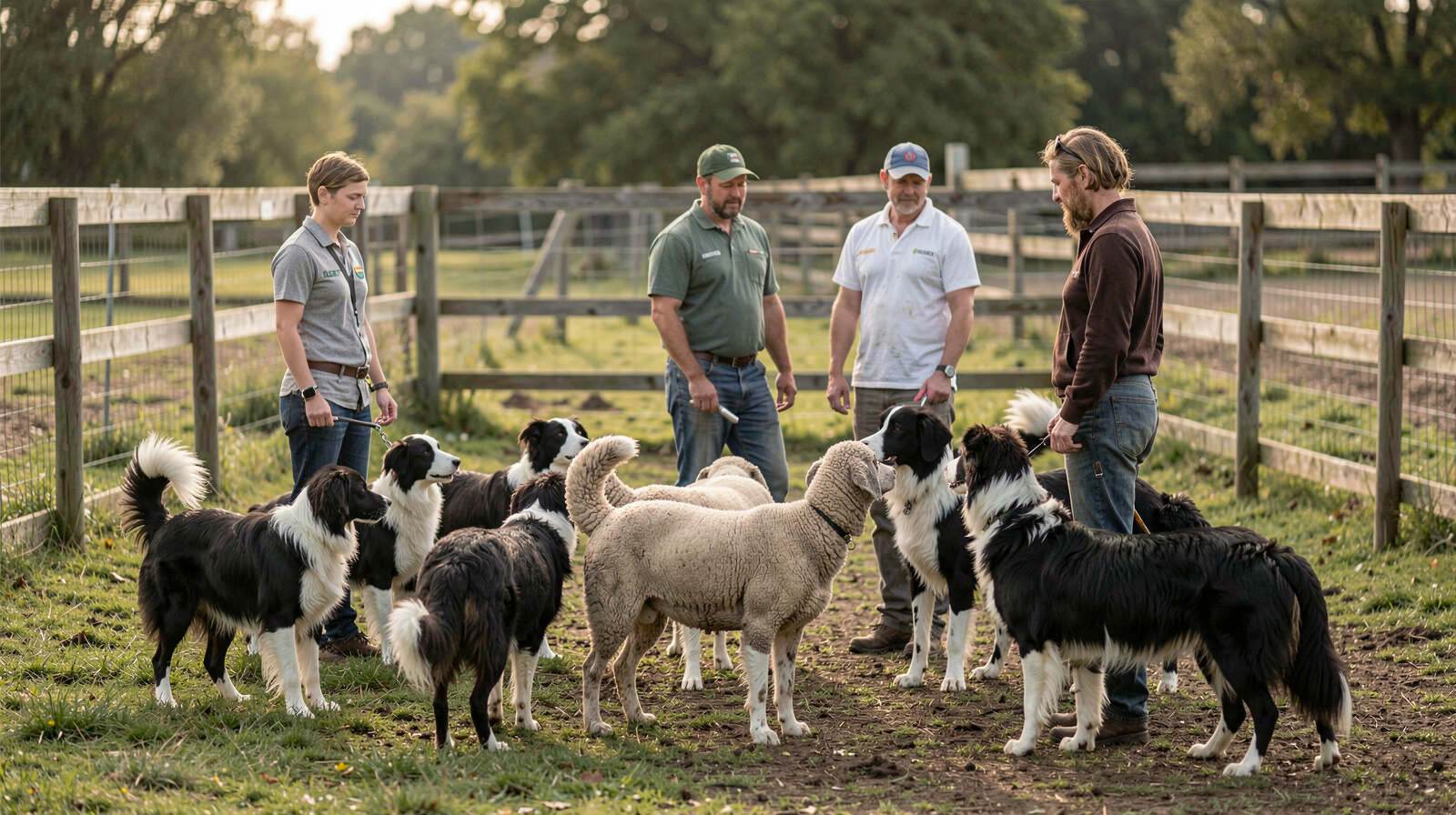
From Spectator to Participant
There is a point where watching trials stops being enough and you want to put your own dog on sheep. That step is harder to take than buying a ticket to watch a trial as a spectator, because now you need a teacher, you need access to stock, and you need to admit out loud that you and your dog are beginners. This guide is the practical funnel from there to your first real lesson: how to find someone worth learning from, what the early sessions actually look like, and how to behave when you get there.
You cannot teach yourself herding from videos. The timing is too fast, the stock too unforgiving, and the feedback loop too subtle to self-coach in the early stages. Almost everyone good started under an instructor, and the quality of that first instructor shapes how fast you progress and whether your dog ends up confident or confused.
Finding Instructors and Clinics
Good herding instructors rarely advertise the way other dog trainers do. They are found through the working-stockdog community, not through a search for “dog obedience near me.” Start with the trial circuit itself: the people running and competing at local trials know who teaches in the region, and most are happy to point a polite newcomer toward a good name. Breed and registry organisations that govern the sport maintain contacts and clinic calendars. Established trainers travel to give clinics hosted at working farms, and those host farms often run regular lessons between clinics.
A clinic and a weekly lesson are different things, and you want both eventually. A clinic is a one- or two-day event, often with a visiting clinician, where a group of handlers each get timed slots on stock and everyone watches everyone else. A lesson is a shorter, regular session with a local instructor on their own sheep. Clinics are concentrated, intense, and good for a periodic reset; weekly lessons are where steady progress actually happens. Many beginners start by auditing a clinic, meaning attending to watch rather than to run a dog, which is the cheapest, lowest-pressure way to find an instructor whose approach you trust.
Instinct Test Versus Started-Dog Lesson
Your very first session will be one of two things, and it helps to know which you are signing up for.
An instinct test is an introduction, not a lesson. A young or untrained dog is put on quiet, dog-broke sheep in a controlled pen or small paddock while an experienced person reads how the dog responds: does it circle the stock, show interest in gathering or balancing, grip, ignore the sheep entirely, or panic? The point is to see what raw material is there. An instinct test does not train anything; it tells you whether and how your dog wants to work, and gives the instructor a starting read. Most dogs of working breeding will show something, and the test is mainly for the handler’s information and the instructor’s planning.
A started-dog lesson is for a dog that is already past the introduction and learning actual mechanics: holding a balance point, taking direction, beginning to flank one way and the other. If your dog has never been on stock, you want an instinct test or an introductory session first, not to be dropped into a structured lesson. Be honest about where your dog truly is. Overstating your dog’s experience to an instructor wastes the slot and can frighten a green dog by putting it under more pressure than it is ready for. Learning the vocabulary of the field before you arrive will help you understand what the instructor is asking for.
Questions to Ask and Red Flags to Watch
You are interviewing the instructor as much as they are assessing your dog. A few questions sort the good from the rest. Ask what their training approach is and whether they will explain why they do what they do; a teacher who cannot explain their reasoning cannot transfer it to you. Ask what stock you will be working on and how the sheep are kept and rotated, because a school running tired, sour sheep teaches dogs bad habits. Ask how they handle a dog that grips, and how they introduce pressure, because the answers reveal whether they train through patience or through intimidation.
The red flags are worth taking seriously. Walk away from anyone who reaches first for harsh corrections, heavy hardware, or fear as a primary tool; herding is built on a dog’s instinct, and an instructor who suppresses the dog rather than shaping it will set you back. Be wary of a trainer who will not let you watch a lesson before booking, who cannot give a straight account of their own competition or training background, who keeps stock in visibly poor condition, or who guarantees fast results. Good herding training is slow, individual, and honest about setbacks. Anyone promising a finished dog on a timeline is selling something.
Trust your read of how the dogs around the place behave. Dogs that are confident and keen around a trainer tell you more than any sales pitch. Dogs that are shut down or anxious tell you something too.
Clinic Etiquette
When you get to a clinic or a lesson, the unwritten rules matter as much as the training. The community is small, and a beginner who shows respect is welcomed; one who does not is quietly not invited back.
Arrive early and stay to help. Gates need manning, sheep need setting and shifting, and the people who pitch in are remembered warmly. Keep your dog crated, leashed, and quiet when it is not your turn; a loose or barking dog at the fence ruins everyone else’s slots and frightens the working stock. Watch every run, not just your own, because most of what you learn at a clinic you learn by watching others get coached through the same problems you have. When it is your turn, do what the clinician asks even if it is not what you would do, because you came to learn their method, not to defend your own. Take correction without arguing; the instructor is reading the dog and stock far faster than you can, and the clinic floor is not the place to debate.
Respect the sheep above all. They are doing hard, repetitive work in the heat for the benefit of everyone’s dogs, and a school that runs out of fresh, fit stock has nothing to teach on. Do not let your dog over-pressure or grip tired sheep, follow the host’s rules on rotating stock, and treat the animals as the irreplaceable resource they are.
The Honest Expectation
Your first sessions will be humbling. Your dog may do almost nothing, or far too much, and you will feel like you understand less leaving than you did arriving. That is normal and correct. Herding is a long apprenticeship for both ends of the leash, and the handlers who get good are simply the ones who kept showing up, kept their mouths shut at the right moments, and let a good instructor and a lot of patient repetition do the work. Find the right teacher, behave well, protect the stock, and the rest is time. When lessons turn into a first entry, the paperwork starts earlier than most people expect: writing the dog’s description on a trial entry form is the field that stalls the most new handlers.