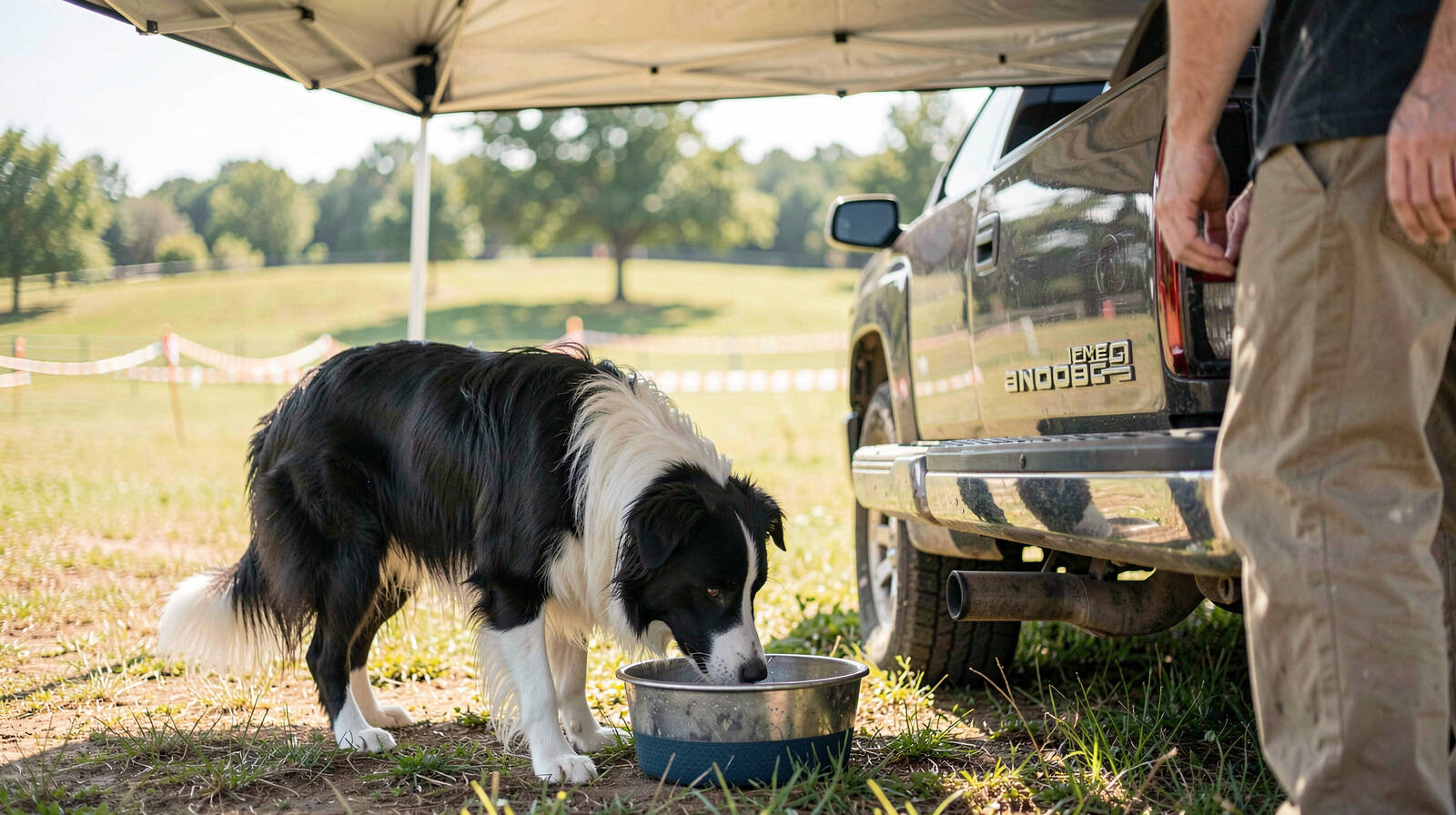
Why the Trial Field Is a Heat Trap
Herding trials happen on open ground in the middle of summer. The course is a wide field with no shade between the post and the far end, the sun is overhead, and the dog is asked to sprint a long outrun and then work at pace for several minutes. A dog cools itself almost entirely by panting; it has very few sweat glands and none that matter for dumping heat fast. Put a hard-running dog on a hot, exposed field and its core temperature can climb dangerously within minutes, well before the run is over.
Heat injury in working dogs is not rare bad luck. It is a predictable hazard of the environment the sport runs in, and it is almost entirely preventable with knowledge the handler controls. This is a welfare issue first and a performance issue second, though the two point the same way: an overheated dog is both at risk and working badly.
Recognising Heat Stress Early
The single most important skill is catching heat stress in its early stage, because early heat stress is fully recoverable and advanced heat stroke can be fatal even with treatment. Learn the progression and you will pull a dog before it is in danger rather than after.
Early warning signs come before collapse. Watch for panting that becomes frantic and noticeably wider than the dog’s normal working pant, with the tongue spatula-shaped and hanging long and wide. The dog’s pace slacks off, its outrun shortens, it stops covering its sheep with the usual snap. Some dogs seek the handler instead of the stock. Bright red gums and tongue, thick or ropey drool, and a glassy or distracted expression are all signals that the dog is shedding less heat than it is making.
The danger signs mean stop now: staggering or wobbling, vomiting or diarrhoea, gums that turn pale or bluish or brick-dark rather than healthy pink, a dog that becomes disoriented, unresponsive, or collapses. A dog showing any of these is a veterinary emergency. Cool it immediately, as below, and get it to a vet, because heat stroke damages organs in ways that can show up hours later even once the dog looks recovered.
If you cannot read your own dog’s normal under load, you cannot read its abnormal. Knowing your dog’s baseline pant, recovery time, and working pace is part of the same attentiveness that makes a good handler-and-dog partnership in the first place.
Hydration: Before Beats During
The most useful rule about water is that hydration is won before the run, not during it. A dog that drinks a large amount immediately before sprinting an outrun is at risk of a sloshing stomach and, in deep-chested breeds, of bloat; a dog that tries to drink mid-work is a dog that has stopped working. The goal is a dog that arrives at the post already well-watered.
Offer water steadily through the hours before a run rather than one big drink at the post. Many handlers add water to food and offer frequent small drinks in the crate and shade between classes. Plain cool water is the foundation. In hot conditions, electrolytes can help a dog that is drinking plenty but still losing salts through heavy panting and drool, but they are a supplement to water, not a replacement for it, and a dog that will not drink plain water will not be saved by electrolytes alone. Avoid ice-cold water in large gulps on a very hot dog; cool water in modest amounts is gentler on a stressed system.
After the run, let the dog catch its breath for a minute, then offer cool water in small repeated amounts rather than letting it gulp a full bowl at once.
Cooling a Hot Dog: The Method That Works Fastest
When a dog is overheating, the priority is to drop its core temperature as fast as possible, and not all cooling methods are equal. The fastest practical field method is whole-body immersion or dousing with cool water: getting cool water onto and over the dog’s whole body, including dunking the head and trunk where you can, moves far more heat than a damp towel laid on the back.
A wet towel draped over a hot dog is one of the most common field mistakes. It quickly warms to the dog’s temperature and then traps heat against the body like an insulating blanket, slowing cooling rather than speeding it. If you use towels, keep them soaking wet and keep swapping and re-wetting them constantly, and concentrate water on the areas where large blood vessels run close to the surface: the belly, the groin, the armpits, and the feet, alongside the head and trunk.
Pair water with airflow. Pour or spray cool water over the dog and then move air across the wet coat with a fan or even by walking the dog gently into a breeze, because evaporation off a wet dog in moving air pulls heat out fast. Cool water plus moving air beats either one alone. Keep cooling until the dog’s panting settles and it brightens up, then stop and continue offering small drinks; over-cooling a dog into shivering is also possible, though far less common than the overheating you are treating.
Carry the kit before you need it. Several gallons of water beyond what the dog will drink, a couple of towels, a collapsible bowl, and shade you can set up yourself, a crate cover, a pop-up, the shaded side of the vehicle, turn a hot trial from a gamble into a managed risk.
When to Scratch a Run
The hardest call in hot-weather trialling is the decision to not run. Scratching a run you have travelled and paid for, perhaps when you are placed well, asks a handler to put the dog ahead of the result, and the handlers who do it consistently are the ones whose dogs have long careers.
Scratch when the conditions plus your dog add up to real risk: a dog already showing early heat signs from a previous run that has not fully recovered, a midday slot on a brutally hot, still, exposed field, or an older or heavily-coated dog that struggles in heat. Use the cooler ends of the day when you can; many summer trials run early and late deliberately. Pre-cool the dog before its run, not just after. And treat your own dog’s history as data, because a dog that has overheated once is more prone to it again and deserves a wider margin.
This is a different kind of judgement from the strategic reading of weather and terrain that handlers use to score better. That is about winning the run. This is about the dog walking off the field healthy, which on the hottest days is the only result that matters. A scratched run costs you a placing. A run pushed too far in the heat can cost the dog far more, and no ribbon is worth that trade.
Heat is not the only physical load a dog carries onto the field. A thick, heavy coat holds warmth and slows the evaporation that cools a working dog, so handlers who trial in summer often clip or thin the coat before the season starts. Breed matters here: a dog built for cold, dense weather works hotter than a lighter-coated one. Owners of flushing breeds can compare notes on insulation and grooming in this guide to cocker spaniel coat and health, then apply the same logic to their trial dog: less coat, faster cooling, and a shorter recovery between runs.
Heat safety does not end when the run is scratched. A dog that has worked in full sun for ten minutes is tired in ways a short rest will not fix, and the days after a trial ask for the same steady routine that keeps any working dog sound. Owners who also keep a pet at home can read daily care for a cocker spaniel for the basics of grooming, feeding and a calm house, which apply just as well to a trial dog between events.
Heat is not the only hazard a working dog meets on a summer trial field. A dog that pants hard, digs at the ground, or chews fence posts and water buckets between runs is often a dog with nervous energy and a full mouth. Giving it something safe to bite matters as much as giving it shade and water. Untreated wood, natural branches, and palm are covered in this guide to reading chew material safety, including wear checks, sizing, and when to replace an item. Pack one before you leave for the trial.
Heat safety does not end when the run is scratched or the dog has cooled down. Handlers who trial in summer often keep a second dog at home, and that dog’s coat and body condition affect how quickly it overheats on a warm day. Breed matters here: a cocker spaniel coat and health guide explains how a heavy, dense coat holds heat and what screening a sporting breed needs before summer work. Knowing the dog in front of you is the first step in any hydration plan.
A dog that has learned to settle in the shade between runs carries that habit home, and the same steady routine of water, rest and a cool floor keeps a working dog sound through a long season. Owners of other breeds face the same question of daily management, and the guide to daily care for a cocker spaniel sets out grooming, feeding and exercise needs in plain terms. Read it alongside your trial plan, then decide what your own dog needs before the next hot weekend.
Cooling a dog after a hot run is only half of the preparation. The other half happens before the season starts, in the kennel and the crate, where a dog that chews hard can damage teeth or swallow splinters from the wrong item. Checking wear, sizing, and replacement rules for untreated wood, natural branches, and safe metals takes a few minutes, and it prevents a mouth injury that would end a trial day faster than heat. Handlers who want a practical checklist can start with reading chew material safety before the next outing.