The Problem Nobody Warns You About
Your dog knows come bye. It knows away to me, lie down, walk up, steady. You have spent months building that vocabulary with your voice, and it works beautifully at fifty yards. Then you stand at the post of an Open-length field, four hundred yards of grass between you and your dog, and your voice simply does not arrive. Wind takes it. The dog keeps working off its own judgment because the signal never reached it.
The fix is the whistle, and here is the part that surprises people: learning to whistle is a separate physical skill from learning the commands. This article is not about what the whistles mean. The meaning is already settled the moment you decide which tone equals come bye. This is about the thing that actually stops most handlers cold: getting a clean, loud, controllable sound out of a small triangle of metal you hold against the roof of your mouth.
It feels impossible for the first week. Then it clicks. Here is how to get there faster.
Voice vs. Whistle, and Why You Need Both
Voice commands carry emotion, and at close range that is fine. But emotion is exactly what you do not want to broadcast across a windy field. The whistle is clean: it is either the right note or the wrong note, with no anxiety leaking through. It also carries. A properly blown shepherd’s whistle cuts through wind and distance in a way the human voice never will.
None of that replaces the meaning you have already taught. The vocabulary of flanks and stops is the same whether you say it or whistle it, which is why the language of whistles and commands on the trial field is worth understanding before you ever pick up the tool. What follows assumes your dog already responds to voice. You are not retraining the dog yet. You are training your own mouth.
Choosing a Whistle You Can Actually Use
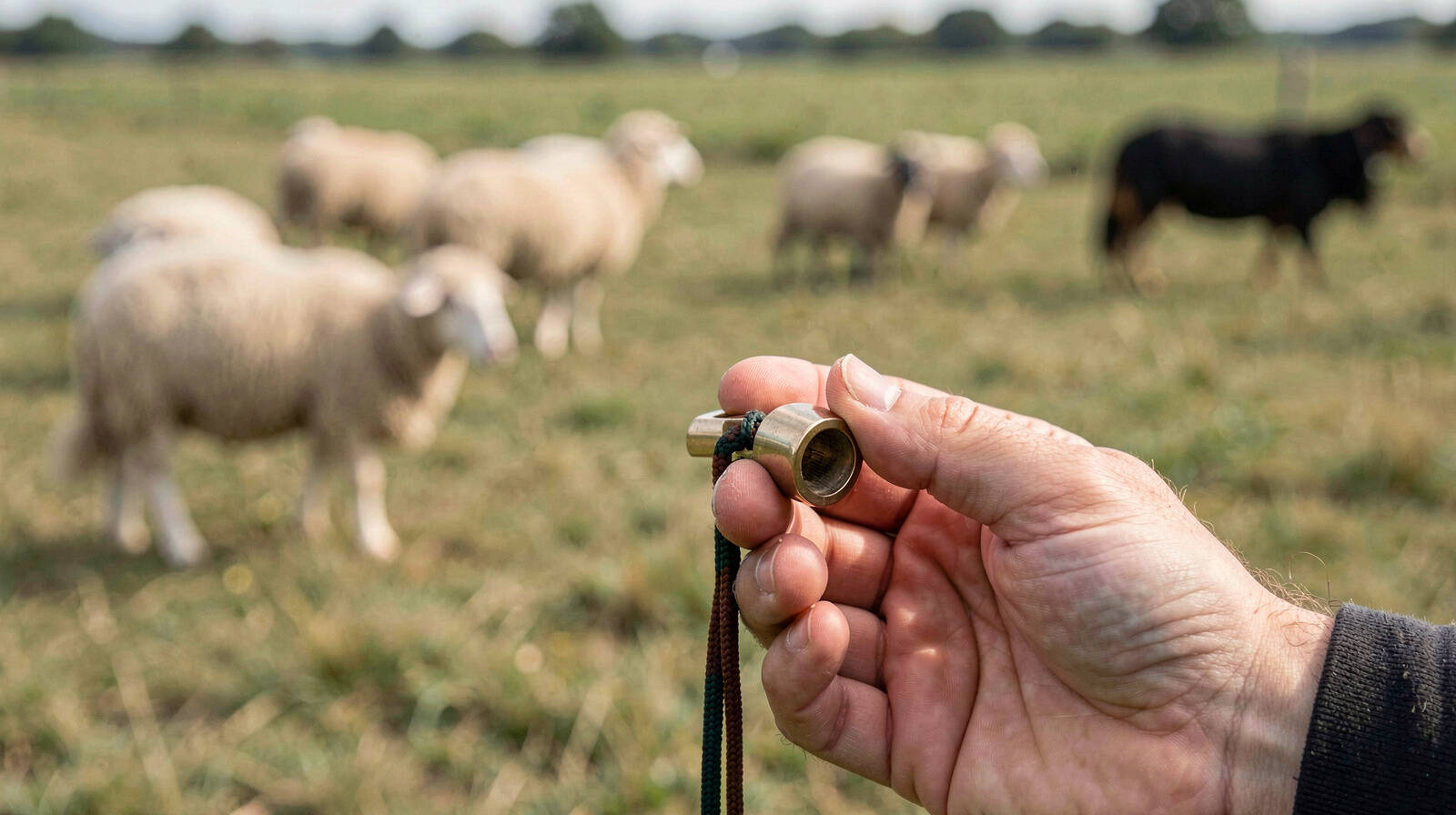
The classic tool is the shepherd’s whistle, also called a sheepdog or Welsh whistle: a small triangular or curved plate, usually stainless steel, sometimes brass or plastic. Buy two or three of different shapes. Mouths differ, and the whistle that produces a clean tone for one person feels useless to another. This is the single most common reason beginners give up: they assume they are failing when really the whistle shape does not suit them.
A few practical notes:
- Stainless steel is the standard. Durable, cheap, easy to clean.
- Plastic whistles are slightly more forgiving for absolute beginners and a good way to find out whether a shape suits you before buying metal.
- Curved vs. flat changes how the plate sits against your palate. If you cannot get any sound after a day, switch shapes before switching techniques.
Keep a spare on a lanyard. They are easy to drop, easy to lose in long grass, and you do not want to discover at a trial that you only own one.
Where the Whistle Sits in Your Mouth
This is the part written instructions handle badly, so read it slowly and then experiment.
The whistle goes inside your mouth, not between your lips like a referee’s whistle. The flat plate rests against the roof of your mouth, the rounded or pointed apex facing inward toward your throat, the opening facing forward toward your teeth. Your tongue sits underneath and slightly behind it.
The sound is not made by blowing through a hole. It is made by your tongue and air forcing a controlled stream across the edge of the whistle, the same physics as blowing across the top of a bottle. Your tongue is the most important part of the entire system. It shapes the air, it stops and starts notes, and it controls pitch.
Hold the whistle in place with light tongue pressure at first. You will want to clamp it with your teeth or lips. Resist that. The whistle should be held mostly by your tongue against your palate, leaving your tongue tip free to move.
Getting That First Clean Tone
Expect noise before music. Most people produce a breathy hiss, a wet splutter, or nothing at all for the first several sessions. That is normal and means nothing about your eventual ability.
Work through it in this order:
- Position the whistle flat against your palate, tongue underneath.
- Curl your tongue tip gently up toward the front edge of the whistle, creating a small channel for air.
- Push a short, firm puff of air across that channel, the way you would whistle across a bottle, not a hard blow.
- Hunt for the tone by moving your tongue a millimeter at a time. The clean note lives in a very narrow position. When you find it, freeze everything and feel exactly where your tongue is.
The first real tone is a small revelation. It is loud, sometimes startlingly so. Once you find it, do not chase volume or pitch yet. Just reproduce that one clean note over and over until your mouth remembers the position without searching. Five minutes a day of nothing but that single tone will get you further than an hour of frustrated experimenting.
A warning every experienced handler will confirm: practice alone, away from your dog. A dog that hears chaotic, meaningless whistling all day learns to ignore whistles. Protect the signal by keeping your fumbling private. Practice in the car, in the shower, walking the dog on a long line with no working expectations.
Building Pitch Control
Once you own one reliable note, the real work begins, because commands need different notes that the dog can tell apart at distance. Pitch on a shepherd’s whistle is controlled almost entirely by the tongue and the shape of the air cavity in your mouth, not by blowing harder.
- Higher pitch: raise the back of your tongue and shrink the space, the same shape your mouth makes on an “eee” sound.
- Lower pitch: drop and relax the tongue, opening the cavity, closer to an “aww” shape.
- Sliding notes: move smoothly between those shapes while keeping the air flowing. Rising and falling slurs are the backbone of most flanking whistles.
Practice three things in isolation: a clean high note, a clean low note, and a smooth slide between them. Then add articulation: use your tongue tip to chop the airflow into short, separate pulses. A sharp double-blast, a long held note, two quick pips, these crisp, repeatable patterns become the actual command shapes. The dog does not need musical beauty. It needs notes that are distinct and identical every time you blow them.
Distinctness matters more than anything. Come bye and away to me must be impossible to confuse at four hundred yards in wind. Build in obvious contrast: if one is a rising slur, make the other a falling one. Vague, similar whistles produce a dog that guesses, and a guessing dog is a scattering of sheep.
Transferring Voice Commands to the Whistle
Only when you can produce clean, distinct, repeatable notes on demand do you bring the dog in, and you do it by pairing, not replacing. For each command, give the familiar voice cue the dog already obeys, then immediately follow it with the whistle tone you have assigned to it. Voice, then whistle, then let the dog act. Do this consistently and the dog bridges the association from the known sound to the new one, exactly the way any conditioned cue transfers.
Introduce one command at a time. Most handlers start with the stop, the lie-down whistle, because a reliable stop is your safety brake and the easiest to confirm. Once the dog drops to the whistle alone, drop the voice for that one command and add the next. Rushing this, trying to convert the whole vocabulary in a weekend, produces a confused dog and a frustrated handler.
This pairing work sits inside the larger handler-dog partnership that champions build, and it is slow on purpose. A whistle the dog half-understands is worse than a voice it trusts completely.
The Honest Timeline
Getting a first clean tone: a few days to two weeks of short daily sessions. Owning a handful of distinct, repeatable command notes: a month or two. Having a whistle system your dog responds to as fluently as your voice: a season of real work, no shortcut available.
The handlers who whistle effortlessly at trials were once exactly where you are, spluttering into a piece of metal and wondering if their mouth was simply built wrong. It was not. The skill is unglamorous and entirely learnable. Put in the quiet five minutes a day, protect your dog from your practice noise, and one ordinary afternoon a clean note will ring out and you will realize the hardest part is already behind you.