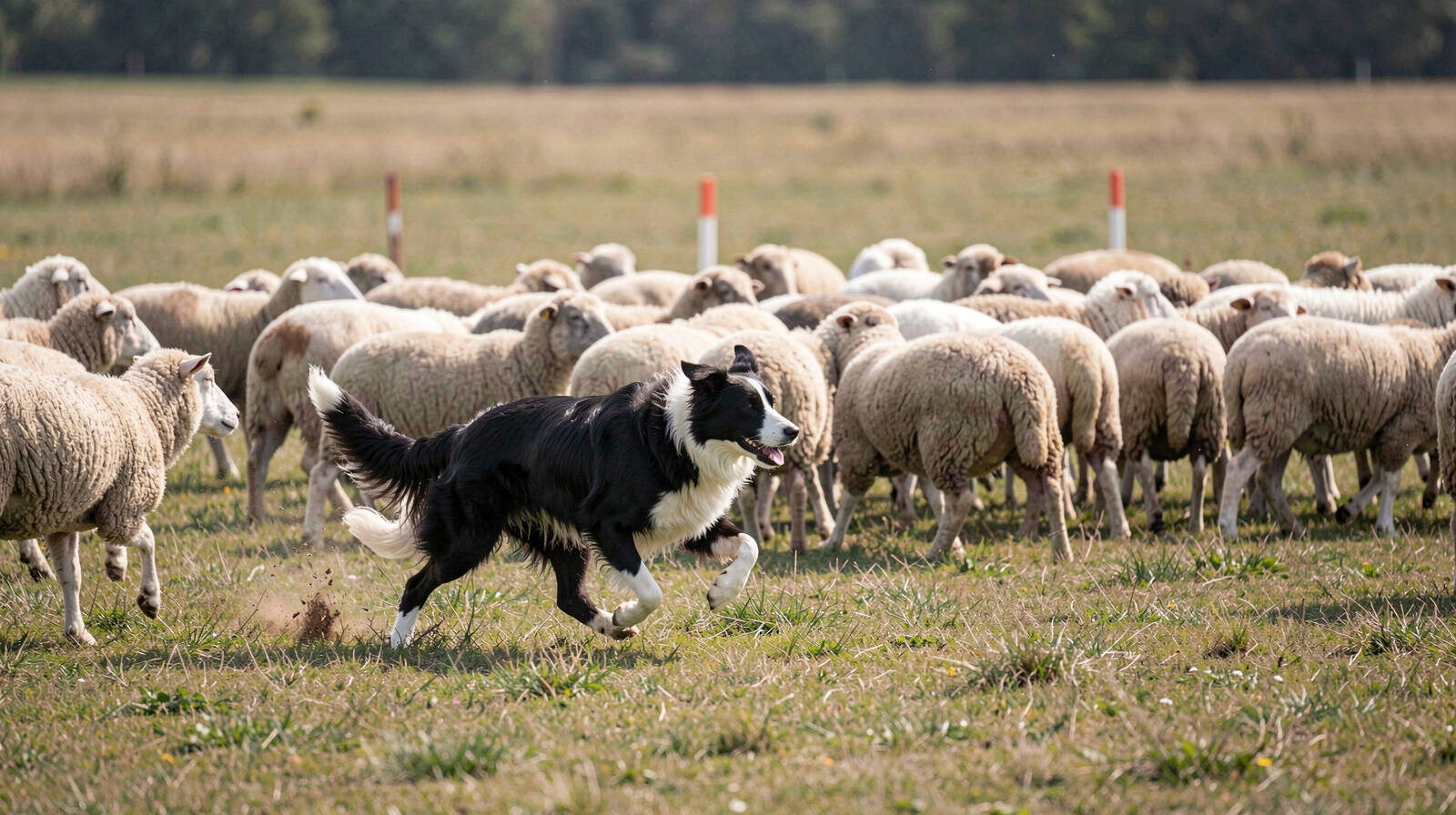
The Run Begins Before You Whistle
Every herding trial run starts the same way. The handler stands at the post, the dog at their side. The sheep are set four hundred yards away, or three hundred, or sometimes more, depending on the trial. The judge is watching. The clock has not yet started.
Then the send whistle sounds, and the dog moves.
What happens in the next twenty to forty seconds, the outrun, is the least dramatic part of most runs to watch. There is no direct contact between dog and stock. Nothing is happening that a casual observer would call action. But experienced handlers and judges know that the outrun is where most runs are made or broken. Not at the pen. Not on the drive. At the very beginning, before the first sheep has been touched.
Understanding why the outrun matters this much requires understanding what it actually is and what a dog is communicating through its shape, width, and pace.
What the Outrun Is Supposed to Accomplish
The outrun is the dog’s approach to the set sheep before gathering them. In trial work, the dog leaves the handler’s side and travels to a position behind the sheep from which it can begin a controlled gather. In Open competition, this is typically a distance of three hundred to five hundred yards. The dog must reach the top of the outrun without disturbing the sheep, positioned behind them and in contact with the stock before beginning the lift.
This sounds simple. The execution is anything but.
A perfect outrun accomplishes three things simultaneously. It covers the distance efficiently, without unnecessary deviation or wasted movement. It positions the dog correctly at the top, behind the sheep and slightly offline, not directly behind them in a way that triggers an immediate bolt. And it does all of this without disturbing the sheep before the dog is in position to gather them, because sheep that are disturbed by an approaching dog before the lift begins are stressed sheep, and stressed sheep behave unpredictably through every subsequent phase.
The whole game of the run hinges on those three requirements being met at once. A dog that covers ground quickly but approaches too tightly triggers the lift before it is ready. A dog that runs wide enough but too slowly allows the sheep to drift before the dog arrives. A dog that gets to the right position but takes a poor line has used more of the time limit than necessary and placed the handler in a reactive posture from the very first moments.
Shape: The Pear That Is Never Actually Pear-Shaped
Handlers and trainers describe the ideal outrun shape as a pear: narrow near the handler, widening progressively as the dog moves toward the sheep, then coming in behind the stock at the top from a position well off to one side. The shape is curved rather than straight, because a dog running in a straight line toward the sheep applies direct pressure that triggers early movement.
In practice, the pear is rarely what you see. Dogs that were trained without enough emphasis on distance work tend to run flat. They move toward the sheep at an angle that narrows steadily rather than widening, and as they approach the top, they are already inside the flight zone before they are in position to gather. This triggers the lift prematurely, before the dog is settled, and the sheep move from stress rather than from controlled pressure.
Dogs that compensate for early training by overextending their outrun take a shape that is too wide. These dogs run so far to the outside that they waste time, often lose sight of the sheep, and arrive at the top from an angle that makes it difficult to pick up the back sheep cleanly. The overlong outrun is less common than the tight one, but it is still penalized.
The correct shape for any given course depends on terrain. A flat field rewards a reasonably standard pear because the sheep and dog can see each other throughout the outrun. A hillside that requires the dog to disappear from the handler’s view for part of the run demands a dog that has been trained to hold its line without visual guidance, because the handler cannot see to correct, and the dog cannot see to adjust to the sheep’s position.
Understanding how terrain and course conditions interact with dog and sheep behavior is inseparable from outrun work, because the ideal shape on one field is a poor choice on another.
Width: The Number That Judges Count Silently
There is an invisible threshold in every outrun, a distance from the sheep’s flight zone beyond which the dog’s approach causes no alarm, and inside which it begins to trigger concern. Every judge at every trial is watching to see whether the dog’s outrun crosses this threshold before the dog is in position.
The flight zone distance varies with the sheep. Trial sheep that have been worked at dozens of competitions have much tighter flight zones than naive training stock. A dog that runs the perfect width on training sheep may run too tight at a major trial simply because the competitive sheep are calmer and more experienced with dogs. This is one reason handlers who only train on a single group of sheep are sometimes surprised by their scores at unfamiliar venues.
Judges penalize when a dog’s outrun causes premature sheep movement. If the sheep begin walking or drifting before the dog is in position at the top, points come off. If the sheep begin trotting, more points come off. If they scatter or bolt, the run has effectively been compromised before it truly began.
The point deduction for a wide outrun, where a dog crosses beyond a reasonable line, is smaller than the deduction for a tight one that disturbs stock. This is not an accident of the scoring system. It reflects the fundamental truth that the purpose of the outrun is to arrive undisruptively. A dog that takes extra time and distance to achieve an undisturbed lift has accomplished the more important objective.
Pace: The Clock and the Dog Do Not Always Agree
The outrun presents a genuine tension between pace and correctness. In time-limited trial formats, a slow outrun costs clock seconds that cannot be recovered. Handlers who run against skilled competitors with fast dogs know that a sluggish outrun, even a correct one, can leave them behind before the run has properly started.
But the dog that runs fast without running correctly pays a higher price. Speed on the wrong line means the dog arrives at the wrong position. Speed into the flight zone means the sheep are moving before the dog can shape them. A fast, wrong outrun damages the run more than a slow, correct one.
The pace question also intersects with dog temperament. Some dogs run their outrun with genuine pace and correctness, because they are both fast and accurate. These are the dogs that make open finals and win trials. They are not common. More frequently, handlers are managing the balance between a dog’s natural speed, which may be too much or too little, and the correctness of line and width that the course demands.
Training the outrun to a consistent pace requires that the handler know what their dog’s natural tendency is and work from there. A dog that naturally runs tight needs steady work on widening without slowing. A dog that runs wide needs work on covering ground without over-qualifying every step. A dog that is genuinely slow needs to understand that release from the post is an invitation to move with purpose.
The training approaches that distinguish consistent competitors almost always include systematic outrun work that addresses the specific fault of the specific dog rather than applying generic prescriptions.
The Lift That Follows
The outrun does not end when the dog reaches the top. It ends when the dog is in position behind the sheep and the lift begins. The transition between these two phases is one of the most critical judgment calls in a run.
A dog that races to the top and immediately pushes forward has not truly completed the outrun. It has arrived and begun the lift without pausing to settle, and the sheep feel that absence of pause. They move faster than they should because the dog is still moving fast. The whole gather gets faster than the handler wants, and control becomes harder to establish.
A dog that arrives at the top, checks its pace, and takes a moment to read the sheep before applying pressure to begin the lift produces a different quality of movement. The sheep acknowledge the presence behind them and begin to move in a considered way. The handler sees the sheep walking rather than trotting. The lift scores cleanly because the pause was there.
This is one of the harder skills to train, because the instinct of a keen dog is to keep moving. Convincing a dog to check itself at the top of the outrun requires that the dog understand its own effect on the sheep well enough to adjust voluntarily. Dogs that have been trained this understanding can do it. Dogs that have only been taught to comply with commands cannot, because the handler cannot issue a pause command at four hundred yards without disturbing the whole picture.
The Reputation the Outrun Builds
Judges see every run. Over the course of a trial weekend, they develop impressions of the dogs competing, and those impressions begin forming at the outrun. A dog that consistently runs a beautiful, wide, settled outrun announces something about its training and its relationship with its handler. A dog that consistently runs tight or disturbs the set sheep announces something else.
This is not about favoritism. It is about information. A dog that demonstrates good outrun work is telling the judge that its handler has done the foundational work correctly, and judges carry that information as a working hypothesis through the rest of the run.
The handler-dog partnership that wins at the highest levels almost always includes a reliable outrun, not because the outrun is the most points on the card, but because the qualities that produce a good outrun, patience, correct distance work, the ability to hold a line without micromanagement, are the same qualities that produce good work across every other phase.
The outrun is not the most exciting thing to watch. But it may be the most revealing.
Frequently Asked Questions
Why is a tight outrun worse than a wide one in scoring?
The purpose of the outrun is to reach the set sheep without disturbing them before the lift begins. A tight outrun that triggers premature sheep movement has failed at this purpose. A wide outrun that takes extra time has been inefficient but has not yet caused damage. Judges penalize disturbance more heavily than extra width for exactly this reason.
How do you train a dog that naturally runs a tight outrun?
Most tight outrun dogs need work at short distance first, where the handler can interrupt and reshape the line without the dog already being committed to the approach. Extending the dog’s path by using a specific send command that the dog associates with a wider cast, combined with consistent redirection when the line begins to flatten, builds a different habit over time. The work is repetitive and slow to produce results, because natural instinct tends to reassert itself under competition pressure.
Does the outrun direction matter? Is an away-side outrun harder than a come-by?
It varies by dog. Most dogs have a preferred side that is consistent through their career, and an experienced handler knows which way their dog is stronger. At trials where the outrun is set to the weaker side, the handler needs to be prepared to intervene earlier if the dog begins to cut in. Judges understand that dogs have preferred sides and are watching for problems on both sides equally.
What should I watch for at a trial to improve my outrun knowledge?
Watch the moment of send, specifically how the dog leaves the handler’s side and commits to its initial direction. Then watch the shape through the middle section of the run, before the dog approaches the top. Flat outruns will show their problem in the middle section long before the dog reaches the sheep. Wide outruns will show their problem at the send. Finally, watch the top: does the dog check its pace before beginning the lift, or does it come in still moving fast?
Is the outrun worth fewer points than the other phases, so why focus on it so much?
The outrun is worth a relatively small number of points compared to the total run score in most formats. But a poor outrun changes the conditions under which every other phase happens. Sheep disturbed by a tight outrun carry that disturbance through the fetch, drive, and pen. The outrun’s influence on the run’s quality is larger than its direct point allocation suggests, which is exactly why experienced handlers invest as much training time in it as they do.