Ten Points That Feel Like Everything
On paper, the pen is worth ten points out of a hundred in most trial formats. One tenth of the total score. By raw mathematics, it is the least significant scoring phase in the run. By emotional weight and competitive drama, it can feel like the only thing that matters.
I have watched handlers who ran clean outrun, fetch, and drive phases lose placements on the pen. I have watched sheep that were manageable through three hundred yards of a drive course suddenly refuse to enter a five-foot-wide opening at the end. I have watched dogs that were brilliant at distance work become tentative and uncertain when the space compressed and the pressure concentrated.
The pen is the moment when everything that has not quite worked throughout the run comes due. Sheep that were light and manageable on the outrun but slightly nervous on the fetch reveal their accumulated anxiety when asked to enter an enclosed space. Handlers who were marginally out of sync with their dogs through the drive find that the marginal desynchronization, not enough to cost many points across four hundred yards of course, is catastrophic on a ten-foot pen approach.
Understanding why the pen is hard, and what it takes to do it well, reveals something important about herding work as a whole.
The Sheep’s Perspective
To understand pen failure, you have to start from the sheep’s perspective. The pen is an enclosed space. Sheep have evolved to distrust enclosed spaces because enclosed spaces are where predators trap prey. Every instinct the sheep carries says: do not enter the small area.
The job of the dog and handler is to create a situation where entering the pen seems like the safest available option. This requires arranging the pressure sources, dog, handler, and the terrain itself, so that the sheep are more afraid of the alternatives than of the pen opening.
This sounds straightforward. In practice, with sheep that have been worked through a demanding course and are already stressed, and with a time clock running, and with the handler’s own anxiety adding to the pressure environment, the execution is anything but simple.
The sheep that have been worked for twelve minutes before reaching the pen are not the same sheep that began the run. They have accumulated stress. They have been pushed and directed and controlled. They are tired and wary, and the pen, which they may have entered many times before, represents in their nervous systems an endpoint to a process they have found unpleasant. Getting them in requires managing all of that accumulated context, not just the final approach.
Deep knowledge of how sheep behavior and psychology affect trial outcomes becomes most critical at the pen, where the stakes of misreading the flock’s state are highest.
The Handler’s Gate
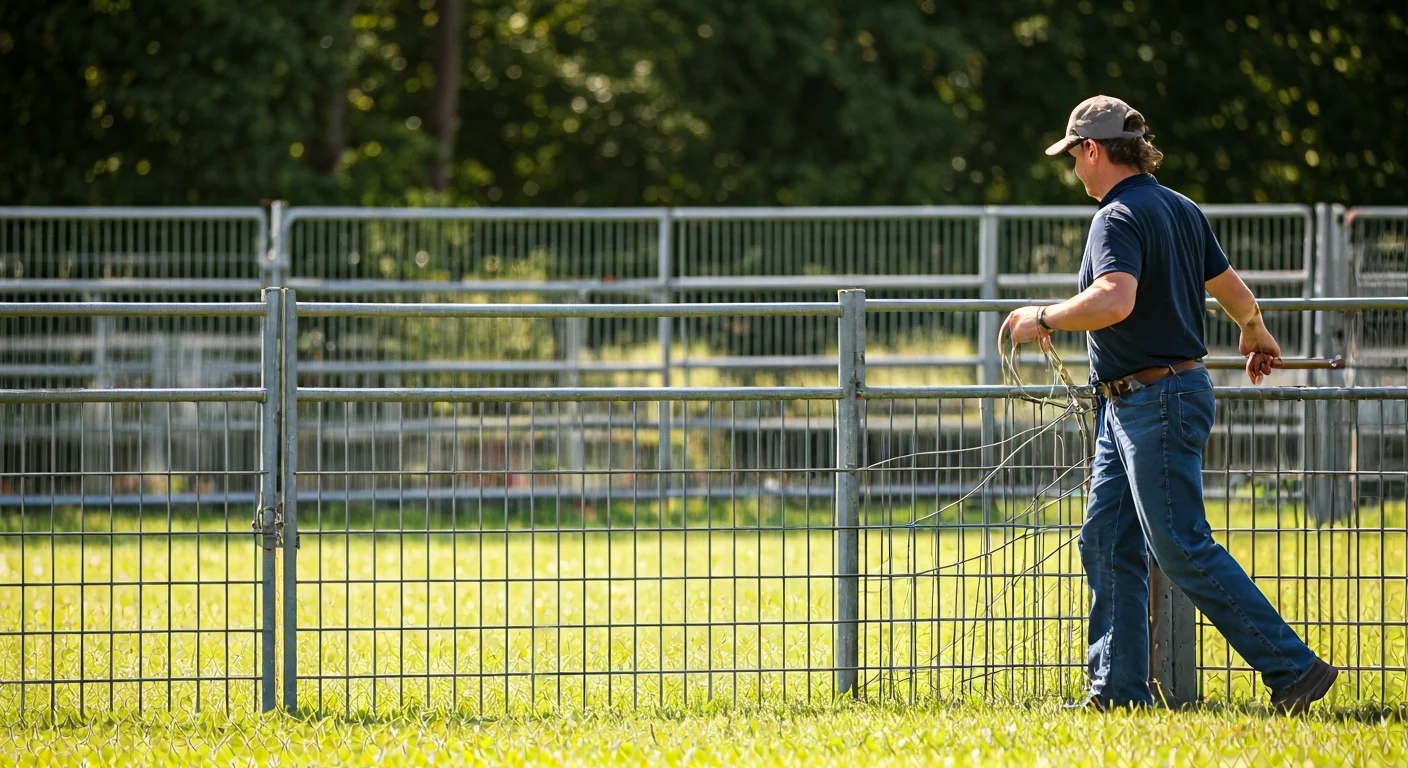
The ten-point pen phase involves one piece of equipment that is almost never discussed in coverage of herding trials: the gate rope. The handler holds a rope attached to the pen gate. One end opens. One end closes. The handler’s job, while also directing the dog through whistles and voice, is to open the gate when the sheep are approaching and close it once they are inside.
This sounds trivial. It is not. The gate creates a pressure zone that the sheep can detect and react to. A handler who moves toward the gate to open it at the wrong moment introduces new pressure at precisely the moment the sheep are evaluating the pen entry. A handler who opens the gate too wide signals to the sheep that they have more space on either side of the opening than they actually do, changing the apparent geometry of the approach.
The judge’s score reflects not just whether the sheep enter the pen but how they enter it. Sheep that walk calmly into the pen, without rushing or bunching at the entrance, score better than sheep that bolt in under panic. Sheep that require multiple attempts cost points for each attempt. Sheep that refuse entirely, or that escape the pen setup entirely and require recapturing, cost significantly.
The handler who manages the gate correctly, neither crowding nor abandoning the presence the gate requires, contributes positively to the pen phase in ways that are invisible unless you are watching specifically for it.
Dog Position During the Pen
The dog’s role in the pen is to provide pressure without triggering panic. This is the same challenge as the rest of the course, but with the geometry compressed to a scale where errors cost immediately rather than allowing space and time for recovery.
On the open course, a dog that is slightly too close can be flanked out, creating space for the sheep to settle. At the pen, there is no space to create. The dog, the sheep, and the pen occupy a small area where every movement has immediate consequences.
The dogs that pen well typically share a quality that is hard to name precisely but that experienced handlers recognize immediately. It is something like patience combined with readiness: the dog is still enough not to trigger panic but present enough to prevent escape. It holds its position through the sheep’s hesitation, through the moment when the lead sheep looks at the opening and evaluates, through the near-decision and the backing away.
“The dogs that can hold still at the pen but come in instantly when called are the ones you want,” a handler who won the National Finals twice told me. “Most dogs do one or the other. The patient ones wait. The reactive ones move. What you want is a dog that can do both.”
Training this quality is not straightforward. Patience and reactivity are partially instinctual and partially trained. Dogs that were rushed through their early stock work development sometimes lack the pen patience because they never learned to be still and trust the pressure they were applying. Dogs that were trained to over-command sometimes move on every whistle even when stillness would serve better.
The way champions structure their training between competitions often includes specific pen work designed to develop exactly this quality: the dog’s ability to be patient at the final obstacle while remaining ready to respond instantly when the situation calls for it.
Time Pressure
Every trial format includes time limits. The Open pen must be completed within the time allotted for the run, and runs that use all of their available time on difficult penning situations sacrifice time that could otherwise allow for recovery from earlier errors.
The psychological effect of the clock on handlers at the pen is significant. In training, where time is irrelevant, most handlers and dogs manage their pen work better than they do in competition. The introduction of time pressure changes the handler’s mental state in ways that directly affect their whistle timing, their gate management, and their ability to read the sheep clearly.
Handlers who freeze at the pen, who cannot make decisions because they are paralyzed by the combination of time pressure, complicated sheep, and accumulated run anxiety, are common enough that experienced handlers recognize the state and have strategies for managing it. The most useful is deceptively simple: focus on the sheep instead of the clock. The sheep will tell you what to do next. The clock will run regardless of what you focus on.
Understanding how judges score each phase and what they are actually watching helps with pen pressure, because handlers who know what the judge is evaluating can focus their energy on influencing those specific elements rather than experiencing a general panic about the situation.
When the Pen Goes Wrong
The variety of ways a pen can fail is instructive about herding work broadly.
The blow-by: Sheep approach the pen and, at the last moment, split and go around both sides of the handler. This typically results from the handler being positioned too close to the gate, blocking the pen entrance from the sheep’s perspective. The solution requires stepping back and repositioning, which costs time and sometimes loses the sheep entirely.
The lead sheep refusal: The dominant sheep in the group reaches the pen entrance, stops, evaluates, and simply declines to enter. The group will not enter without the lead sheep entering first. The handler and dog must maintain enough pressure to keep the lead sheep facing the entrance without triggering a retreat. This can take thirty seconds or two minutes. It is the most nerve-wracking scenario in the sport.
The group split: One or two sheep enter the pen while the others scatter. The dog must choose which problem to solve first: getting the remaining sheep into the pen, or preventing the penned sheep from exiting while the entrance is still open. There is no clean solution to this scenario. Damage control is the best available option.
The escape after entry: All sheep enter the pen, the handler begins to close the gate, and one sheep bolts out before the gate is secure. This costs points but is recoverable if the sheep can be quickly re-entered. The handler’s gate management in the closing moment determines whether this scenario ends with a clean pen or a late and messy one.
What Clean Pens Look Like
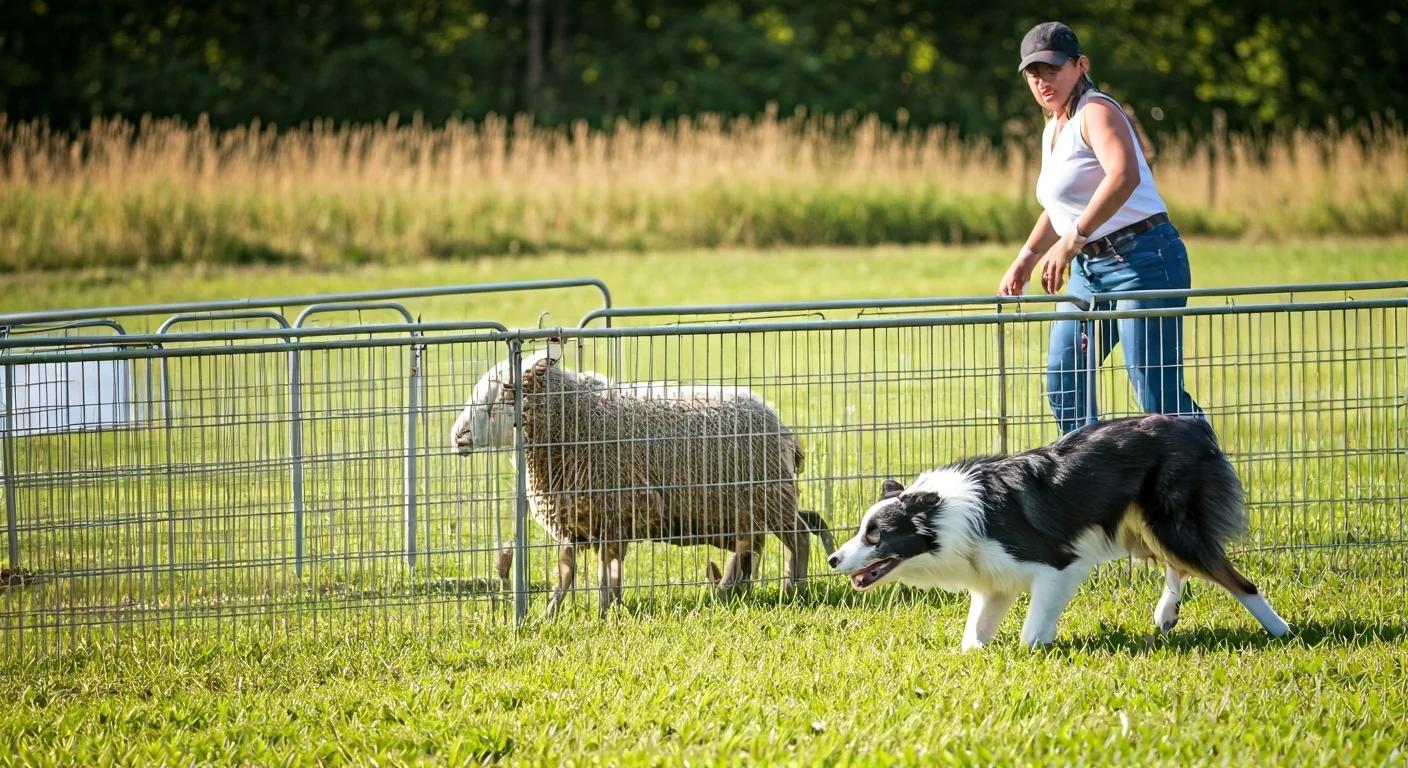
Watching a team that pens well is one of the genuinely beautiful moments in herding trial spectating. The sheep approach steadily. The lead sheep pauses at the entrance, considers briefly, and moves in. The others follow without bunching or rushing. The handler closes the gate quietly. The dog backs a step.
The entire thing might take forty-five seconds. It looks effortless. It is the accumulated product of a handler who read the sheep correctly throughout the run, a dog that maintained appropriate pressure without ever triggering panic, and an approach to the pen that positioned the flock with the geometry that made entry the path of least resistance.
There is no dramatic whistle sequence. There is no last-minute heroics. There is a team that did the right things on the right moments throughout the entire run, and the pen reflects all of those prior decisions.
This is what the handler-dog partnership looks like when it is fully functioning. Not the dramatic rescue, but the clean execution that makes the hardest thing look simple.
Practicing Under Pressure
The pen is the phase most frequently shortchanged in training. Handlers run their dogs on the open course, work on outrun and drive problems, and sometimes treat the pen as an afterthought because the sheep are tired at the end of the training session and not representative of trial conditions.
This is backwards. If the pen is the phase that costs the most points in competition, it deserves the most deliberate practice in training. Specific pen work sessions, with fresh sheep, with time pressure deliberately introduced, and with the full approach geometry simulating trial conditions, develop pen confidence in ways that running the full course and penning tired sheep cannot.
The handlers who pen consistently well in competition practice the pen specifically, frequently, and under realistic conditions. This is one of the clearest separations between developing handlers and competitive ones. The competitive handlers have made the pen a priority in training. The developing handlers have made the outrun and drive a priority because those phases are more interesting to practice and because failure at the pen feels less like a training problem and more like bad luck.
It is rarely bad luck. It is usually a skill deficit that deliberate practice can address. The pen does not forgive shortcuts. It also does not forget good preparation.