What the Fetch Actually Is
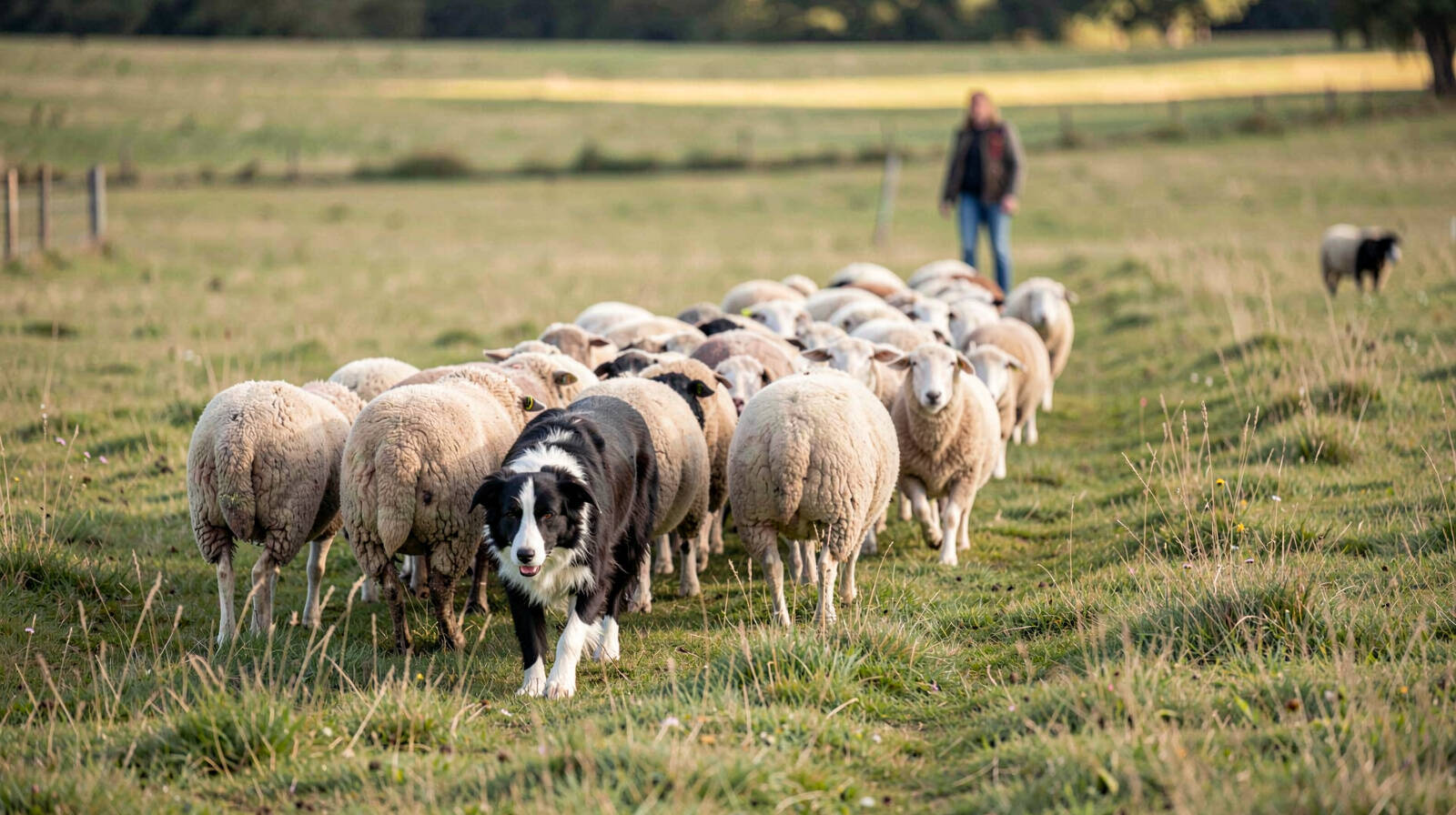
The fetch is the second phase of a standard trial course. It begins the moment the dog lifts the sheep off the set point and ends when the sheep pass through the fetch gates and reach the handler at the post. On paper it is the simplest phase in the run: the dog brings the sheep in a straight line from the top of the field down to the handler, through a single set of gates placed on that line.
In practice, the fetch is where the early part of the run gets either banked or thrown away. A clean outrun and lift puts the sheep in motion calmly and on line. The fetch either preserves that or wastes it. Because nothing dramatic happens during a good fetch, newcomers underrate it. Judges do not. The fetch carries real points, and it is the phase where the difference between a settled team and a nervous one shows up first.
The Line Is the Whole Point
The scored element of the fetch is the line, meaning the straightness of the path the sheep travel from the lift to the gates to the post. The ideal is a single straight line from where the sheep were set, through the centre of the fetch gates, to the handler. Every deviation from that line costs fractions of a point, and fractions add up across a long fetch.
Two failures dominate. The first is missing the fetch gates. Gates are typically a set of two panels the sheep must pass between, placed on the fetch line partway down the field. Missing them is a hard, visible deduction, usually larger than the slow erosion of a wavering line, because the gates are the one objective, all-or-nothing checkpoint in the phase. The second failure is a fetch line that wanders, the sheep drifting left and right as the dog over-corrects behind them. A wavering line that still threads the gates scores better than a confident line that misses them, but both are leaking points the whole way down.
This is the trade-off handlers misjudge under pressure. Faced with sheep drifting off line, a handler will often pile on commands to force them back, and the over-correction throws the sheep past the line in the other direction. The sheep zig-zag, the dog gets tense, and a phase that should look boring becomes a series of saves. The skill is holding a line, not chasing one.
Why Handlers Over-Command Here
The fetch is the phase where over-commanding does the most damage relative to how tempting it is. The sheep are moving toward the handler, fully in view, close enough to read every twitch. That visibility invites micromanagement. The handler sees a sheep’s head turn and issues a flank; the dog responds; the correction is too much; now another command is needed to fix the first. Each command adds pressure to stock that, left mostly alone, would have drifted back to the line on its own.
A dog that has the sheep moving on a good line needs very little from the handler during the fetch. The best fetches are remarkably quiet: a steady dog walking up behind settled sheep, the handler issuing the occasional small correction and otherwise letting the picture hold. Experienced handlers describe the discipline as trusting the dog to carry the line, and trusting the sheep to want to come to the handler, which on a fetch they usually do, because the handler is between them and open ground they would rather not cross alone.
Understanding how sheep read pressure and movement is what makes a quiet fetch possible. Sheep on the fetch are walking toward a human, an inherently uncomfortable direction for them, held there only by the balance of pressure from the dog behind. Read that balance correctly and the line holds itself. Read it wrong and every command makes it worse.
The Dog-Leg Fetch
Not every course runs a straight fetch. The dog-leg fetch is a variation in which the fetch line is deliberately bent, the gates set off the straight line so the sheep must be brought down, turned, and carried on a new heading to reach the post. The dog-leg appears at bigger trials and on courses designed to separate the field, because it removes the comfort of a single straight aim and forces the dog to reshape the sheep mid-fetch.
The dog-leg punishes dogs that rely on momentum. A dog carrying sheep in a straight line at pace has to genuinely slow, take a flank, and re-establish a new line through the turn without letting the sheep speed up or scatter. Handlers who have only schooled straight fetches at home are often caught out by it, the same way handlers who only train on calm stock are surprised by tighter trial sheep at unfamiliar venues. The fix is to school turns into the fetch at home, so the dog learns that a bend in the line is normal work, not an emergency.
Where the Fetch Sits in the Run
The fetch completes the opening sequence of every trial: outrun, lift, fetch. Together these three phases get the sheep off the far end of the field and delivered to the handler, and they happen before the run has properly become a contest of driving and shedding. Their job is unglamorous. They set up everything that follows.
A team that arrives at the post with calm sheep, a clean gate, and a straight line has done more than score a few points. It has kept the sheep settled for the drive and the pen, where stressed stock are far harder to manage. A team that arrives with sheep that have been chased, over-flanked, and bounced off the line down the whole field is now driving rattled animals, and the cost of a poor fetch is paid twice: once in the fetch score and again in everything downstream. That is why handlers who understand the way early phases set up scoring treat the fetch with the seriousness its modest point value does not advertise.
The Takeaway
The fetch rewards restraint. Send the sheep on line off a good lift, let the dog carry them, correct small and correct early, and protect the gates as the one place you cannot afford to be wrong. Resist the urge to manage every step just because you can see every step. The handlers who win do not have flashier fetches than everyone else. They have quieter ones.