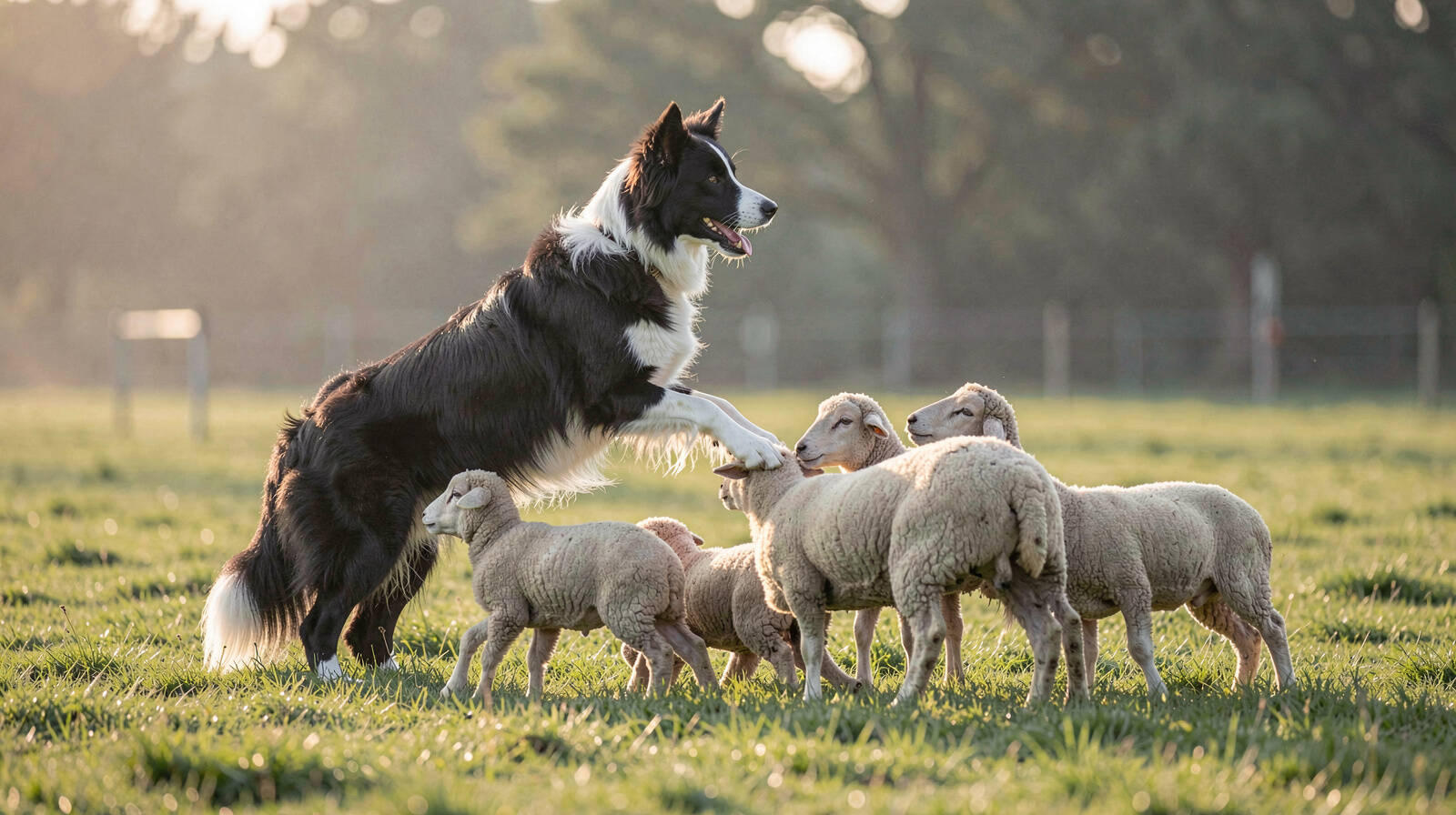
A Handful of Points, the Whole Run
On most scorecards the lift is worth only a few points, often less than ten. By that math it is one of the least valuable phases of a trial. By consequence it may be the most important moment of the entire run.
The lift is the brief instant, three or four seconds at most, when the dog reaches the top of its outrun, arrives behind the sheep, and first sets them into motion toward the handler. Nothing has gone wrong yet. The sheep have not moved. And in those few seconds the dog either settles the group into calm, controlled travel or panics them into a run that will poison every phase that follows.
Judges score the lift small. Experienced handlers treat it as the hinge the whole run swings on.
What Actually Happens at the Top
To understand the lift you have to picture the sheep’s experience. They have been standing at the top of the field, often several hundred yards from the handler, watching a dog sweep around them on the outrun. However wide and clean that outrun was, the moment the dog appears behind them is the moment they decide what kind of run this will be.
If the dog arrives calmly, comes to its balance point, and applies just enough pressure to start them walking, the sheep move off as a settled group. If the dog arrives fast, tight, or off-balance, it snatches the sheep into motion, splits their attention, or sends them bolting down the field. That first impression sets the sheep’s temperature for the entire run, and unsettled sheep do not settle again easily.
This is why the lift cannot be separated from the outrun that precedes it. A perfect outrun that ends in a hard, crashing arrival has thrown away its own value. The two phases are one continuous thought.
Balance, and the First Three Steps
The technical core of the lift is the balance point, the spot directly opposite the handler, behind the sheep, from which the dog’s pressure pushes the group straight toward the post. A dog that lifts off balance pushes the sheep at an angle, and the fetch begins crooked before the sheep have taken three steps.
Judges watch those first three steps closely. They are reading whether the dog found the true balance point or simply ended up wherever its outrun deposited it. They are watching whether the dog paused to take command of the sheep or barged straight into them. A good lift often includes a brief, almost invisible hesitation, the dog steadying itself behind the group, taking the weight of the sheep, before easing them into motion. That pause is not slowness. It is control.
Calm Versus Snatchy
Handlers talk about a “calm lift” and a “snatchy lift,” and the difference is exactly what it sounds like.
A calm lift looks almost boring: the dog appears, the sheep lift their heads, and the group flows off toward the handler at a steady walk, as if the dog had asked politely. A snatchy lift is abrupt: the dog comes in too hot, the sheep jerk into motion, heads up and alarmed, and they often start the fetch already moving too fast or already drifting off line.
The snatchy lift costs almost nothing on the lift score itself, a point or two. Its real cost is collected later, across the fetch and the drive, as the handler spends the rest of the run trying to calm sheep that were rattled in the first three seconds. This is why reading the sheep from the start matters: unsettled stock never fully recovers, and the points bleed out downstream where the judge attributes them to other phases.
How Judges Read the First Contact
Because the lift is short and undramatic, newcomers assume judges barely notice it. The opposite is true. A judge watching the top of the field is reading the dog’s manner of arrival as a preview of the whole run, because it usually is.
They are asking: did the dog come onto the sheep with quiet authority or with aggression? Did it find balance or push from the side? Did the sheep accept the dog or fear it? A dog that lifts sheep with calm command tells the judge it understands pressure, and that confidence colors how the rest of the run is scored. A dog that snatches has announced, in three seconds, that the handler will be managing problems for the next several minutes.
Training a Better Lift
The lift is hard to drill in isolation because it depends on a good outrun arriving in the right place. But the manner of contact can be trained directly. Many handlers practise stopping the dog at the top, before it touches the sheep, so it learns to arrive, steady, and take command rather than crashing through. Asking for a calm walk-up onto settled sheep, rather than a fast flank, builds the habit of easing stock into motion.
Above all, resist the urge to value speed at the top. A fast lift impresses no one and rattles the sheep. The dog that pauses, balances, and lifts gently is the dog whose fetch and drive will look easy, and the work that builds that steadiness happens in the quiet sessions of training between trials, long before the post.
Score the lift small if you like. Just remember that the run you watch unfold over the next several minutes was largely decided in its first three seconds.