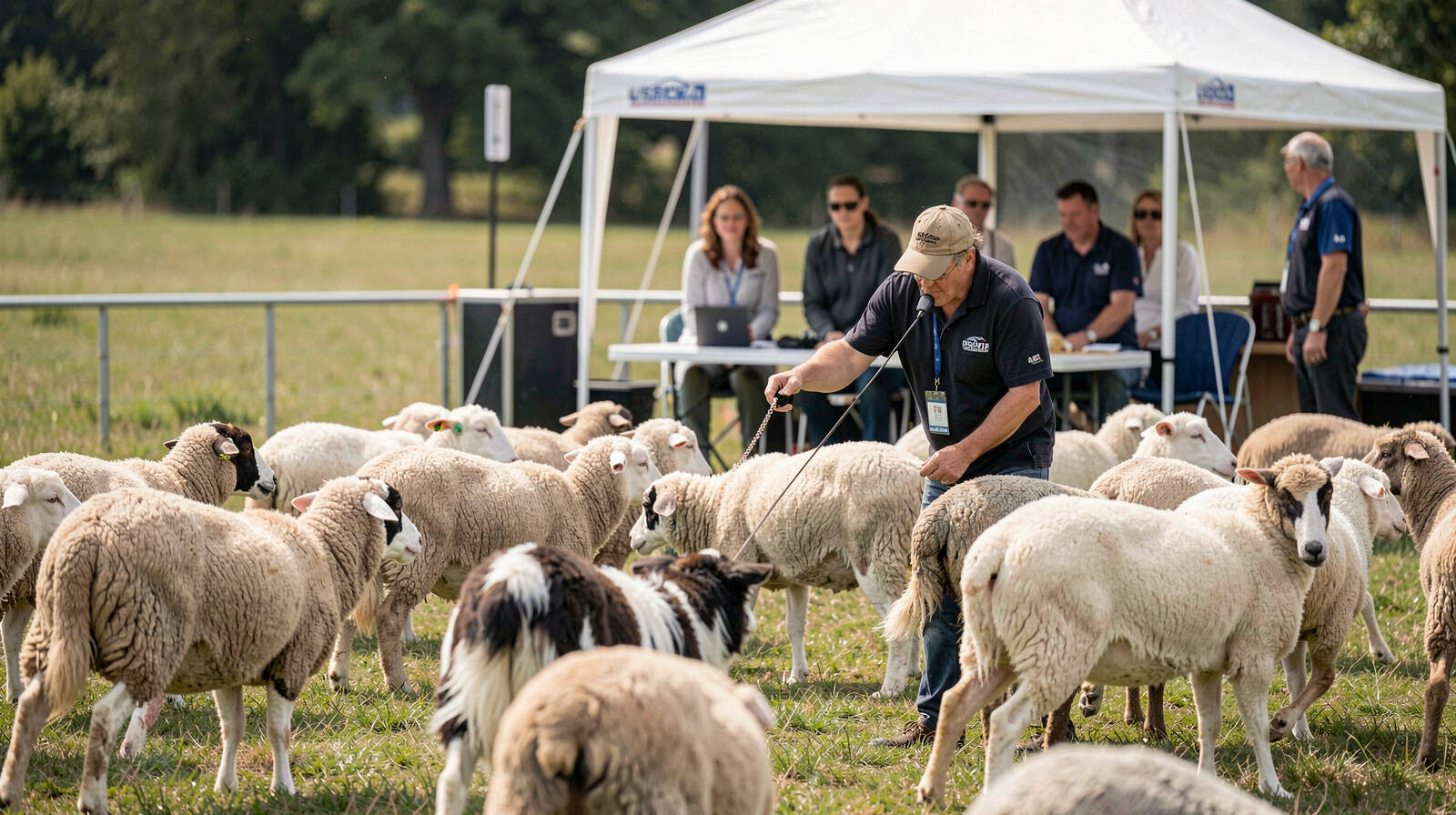
Handlers entering the herding trial world for the first time frequently ask which organization they should trial with. The short answer is that it depends on the breed, the sheep experience available, the handler’s time budget, and the handler’s long-term goals. The longer answer requires understanding that USBCHA Open and AKC Herding are genuinely different sports with different rulebooks, different judging philosophies, and different training implications. A dog prepared primarily for AKC trials will not be competitive at USBCHA Open, and vice versa. Understanding the rulebook differences is the starting point for making a serious long-term training plan.
The Organizations in Brief
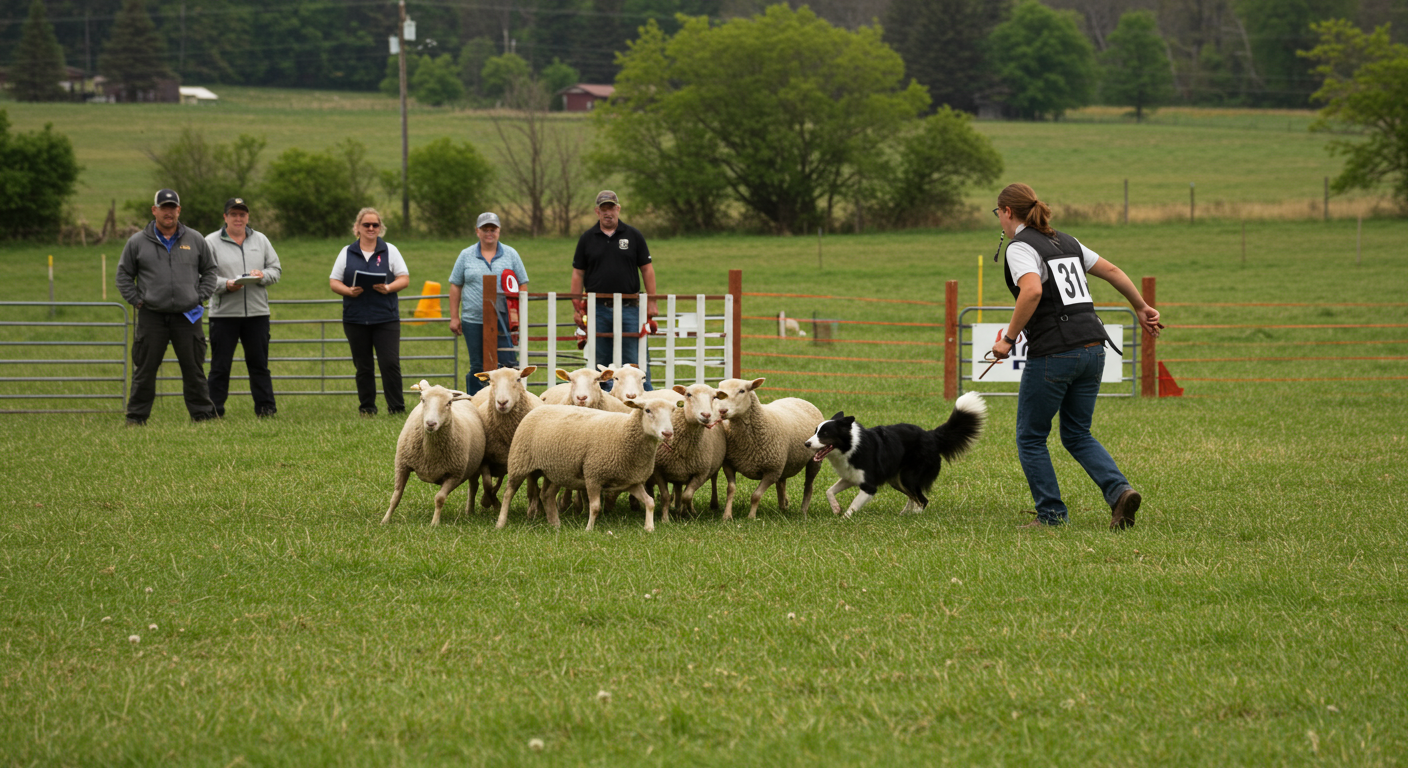
The United States Border Collie Handlers Association (USBCHA) is the governing body for traditional sheepdog trials in the United States. Its trials are modeled after the International Sheepdog Society (ISDS) format that originated in the United Kingdom, with emphasis on distance work, minimal handling, and the full traditional course of outrun-lift-fetch-drive-shed-pen. USBCHA Open is the senior class and represents the highest competitive level in the organization.
The American Kennel Club runs a separate herding program that includes Herding Trial (HT), Pre-Trial (PT), Herding Started (HS), Herding Intermediate (HI), and Herding Advanced (HA) classes across three courses (A, B, and C) using different livestock (sheep, cattle, ducks). AKC herding is open to any AKC-registered herding breed, and the courses are explicitly designed to be approachable for a broader set of breeds beyond the Border Collie-dominated USBCHA circuit.
Breed Eligibility
USBCHA does not restrict by breed. Any dog can be entered. In practice, the top levels are dominated by Border Collies because the course demands — particularly the long outrun and the strong eye required for pressure-based handling — favor the specific working style Border Collies were selected for. Kelpies, some Koolies, and a small number of cross-bred working dogs also compete.
AKC herding is restricted to AKC-recognized herding breeds, including Australian Shepherds, Belgian Sheepdogs, Belgian Malinois, Belgian Tervurens, Bearded Collies, Border Collies, Bouviers des Flandres, Briards, Canaan Dogs, Collies (Rough and Smooth), German Shepherd Dogs, Old English Sheepdogs, Pembroke and Cardigan Welsh Corgis, Pulis, Pumis, Pyrenean Shepherds, and Shetland Sheepdogs. This is the organization to pursue if the handler’s breed is a non-Border Collie herding breed.
Course Design Differences
USBCHA Open Course
- Outrun: 400 to 800 yards, ideally on terrain that challenges the dog’s eye and pace
- Lift: Single set of gates, sheep held calmly at the far end
- Fetch: Back to the handler through a set of panels, minimum 100 to 200 yards
- Drive: Triangle drive of approximately 100 to 200 yards each leg
- Shed: Required, typically requiring the dog to separate specific sheep — sometimes a marked or collared animal
- Pen: Standard catch pen
AKC Course A (Arena Course)
- Setup: Smaller arena or defined area
- Obstacles: Combination of panels, Y-chutes, re-pen, crosses, and other course elements
- Distance: Substantially shorter distances than USBCHA
- Livestock: Sheep, cattle, or ducks depending on judge and venue
- Emphasis: Controlled handling through a sequence of course obstacles
AKC Course B (Farm Course)
- Setup: Simulates a practical farm task
- Obstacles: Gate opens, chute, re-pen, a long fetch, and a drive
- Distance: Between Course A and USBCHA in scale
- Emphasis: Practical farm application rather than distance work
The rulebook differences translate into substantively different dogs. USBCHA Open rewards a dog with strong eye, balance at pressure, and decision-making at long distance. AKC herding rewards a dog with attentive close-work, response to sequential handler commands, and versatility across multiple obstacle types.
Judging Philosophy
USBCHA trials use a deduction-based scoring system where each element of the course is worth a fixed number of points and the judge deducts for errors. A perfect run is 100 points. Deductions come from incorrect outrun lines, pressure application errors, pace losses, misses at the panels, and handler over-commanding. The philosophy rewards clean, economical work where the dog handles most decisions.
AKC herding uses a graded pass-fail system at lower levels (PT, HT) and a scored system at upper levels (HS, HI, HA). The HA class uses a 100-point base with deductions similar to USBCHA in concept but different in calibration. AKC judges reward clean obstacle completion, appropriate response to handler commands, and maintenance of stock control throughout the course. The calibration tends to be more tolerant of handler guidance than USBCHA.
For handlers interested in the scoring details, the understanding scoring guide walks through the deduction categories that apply across both organizations.
Titles and Year-End Recognition
USBCHA does not issue titles. The organization tracks competitive points and runs national championships (the Finals) at each class level. A handler’s public record is the finals qualification history and the rankings for the year, which are published annually.
AKC issues titles that follow the dog’s name in registration documents. Titles earned include HT (Herding Tested), PT (Pre-Trial Tested), HS (Herding Started), HI (Herding Intermediate), HA (Herding Excellent in the senior letter), and HC (Herding Champion) for dogs achieving the requisite qualifying performances. The title structure creates a graduated set of goals that many handlers find motivating for long-term training.
Training Implications
The choice between organizations affects training priorities. Training for USBCHA Open emphasizes:
- Long outrun work, typically starting short and extending to 300+ yards during training
- Strong stop and pace commands usable at distance
- Off-balance flanking, where the dog must flank while the sheep are in motion
- Shedding, which requires months to polish and is typically the final skill developed
Training for AKC herding emphasizes:
- Obstacle-specific work, particularly Y-chute, panels, and re-pen
- Stock-type versatility if the handler plans to trial on multiple species
- Close-range handler communication with precise response to sequential commands
- Controlled stops and recalls in close-quarters arena environments
For a detailed breakdown of the training investment that distinguishes champion partnerships, the training between trials analysis covers the daily practice patterns that top handlers use.
Which Organization Should a New Handler Choose?
For a handler with a Border Collie or Kelpie and access to large flocks of working sheep, USBCHA is the traditional path and has the deepest competitive infrastructure. For a handler with a different AKC-eligible herding breed, AKC herding is the realistic option. Many handlers ultimately compete in both organizations, especially if they have multiple dogs or want to broaden their competitive exposure. The rulebook differences are real but not mutually exclusive — dual-organization trialing is common at the higher levels.
The Broader Context
Both organizations operate within a broader trial landscape that includes the American Herding Breed Association (AHBA), the Canadian Border Collie Association, and various regional associations. Each has its own rulebook. A dog developed primarily for USBCHA Open will be competitive at AHBA in their Advanced Trial Dog class; a dog developed for AKC herding will typically find the AHBA arena classes familiar. For handlers evaluating which dog to buy for a future trial career, our selecting trial dog breeding versus rescue article discusses the breed and bloodline considerations that intersect with organization choice. Whichever rulebook a handler enters under, the first encounter with it is usually the paperwork: what an entry form asks about a dog’s appearance is covered in a separate guide.